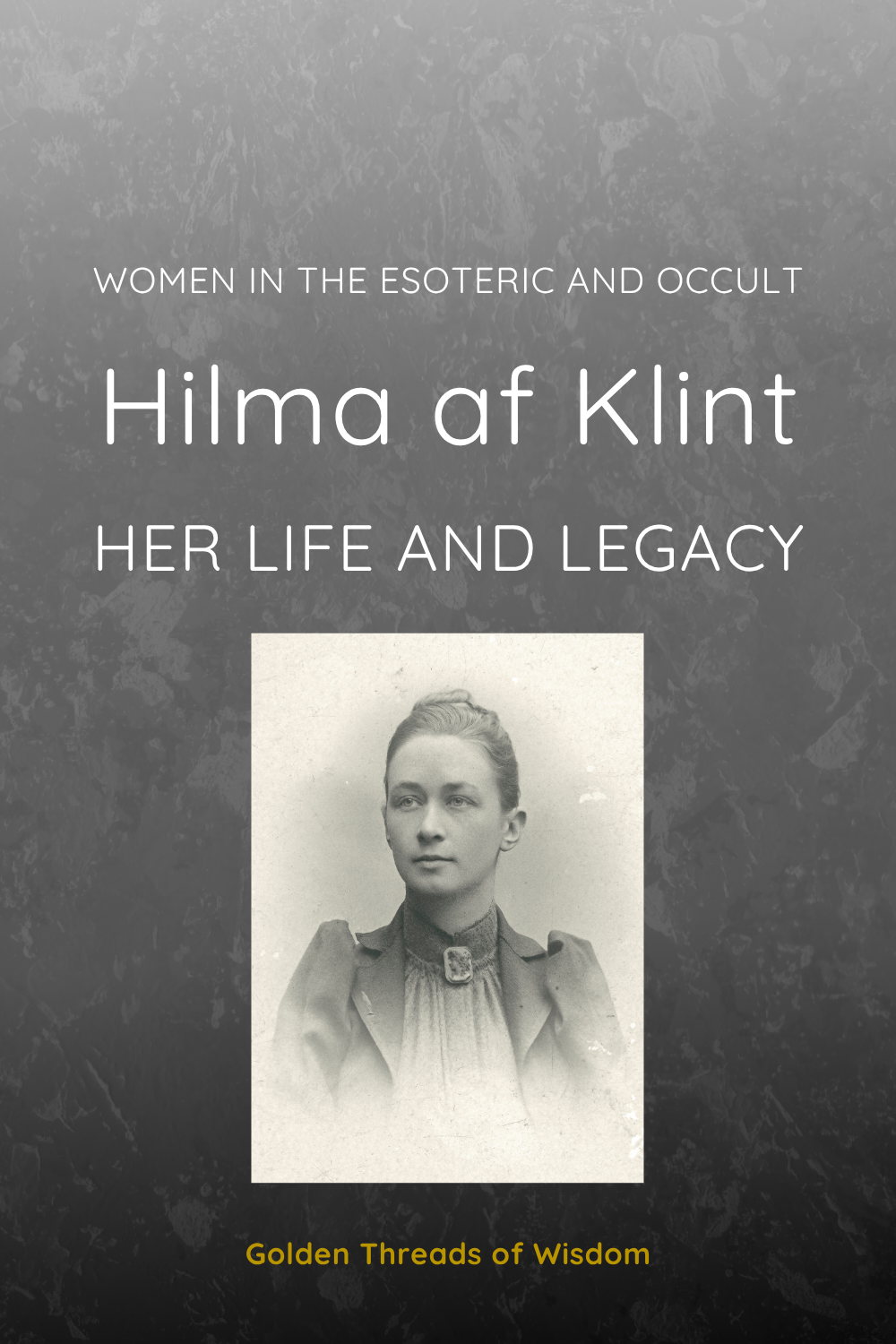
Hilma af Klint: Her Life and Legacy | Women in the Esoteric and Occult
Imagine receiving messages from a source outside yourself that tells you to create art that’s unlike anything you’ve ever created before. Even unlike anything the world has seen before.
Then imagine realizing the world isn't ready for that work. So you stipulate in your will that it shouldn’t be shown until at least 20 years after your death.
And when that day finally comes, when the paintings are unveiled, they completely turn the Western art world upside down. Not only because everything they thought they knew about the origins of abstract art turned out to be wrong, but because the art itself is unlike anything else.
So, who am I talking about? Hilma af Klint, of course. And this is her story.
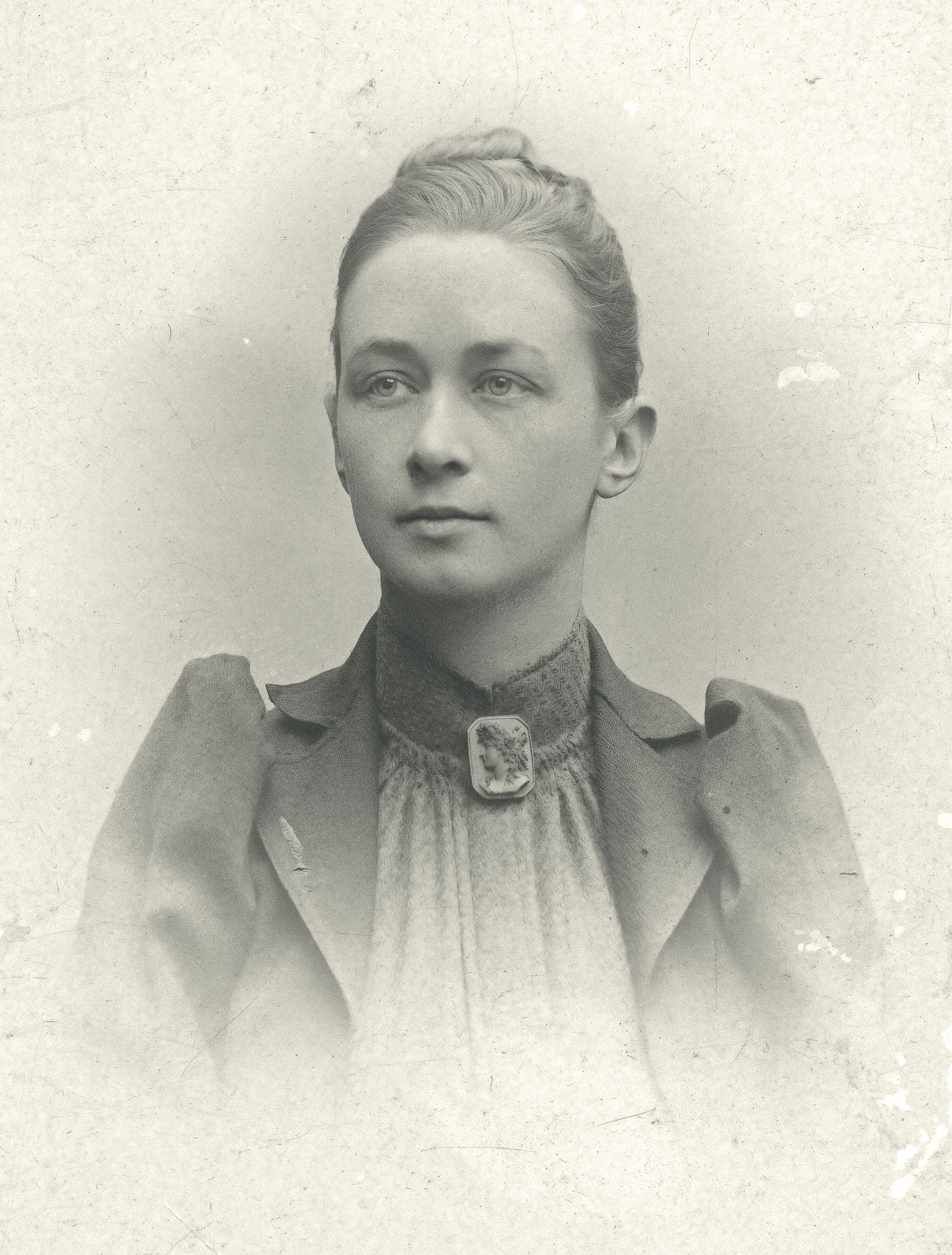
Hilma af Klint, portrait by an unknown photographer
If you want early access to my posts, as well as additional content, join my Patreon.
Her Early Life
Hilma af Klint was born on the 26th October 1862, in Solna, Sweden. Her father was a Swedish naval commander, and Hilma was the fourth of his and his wife's children.
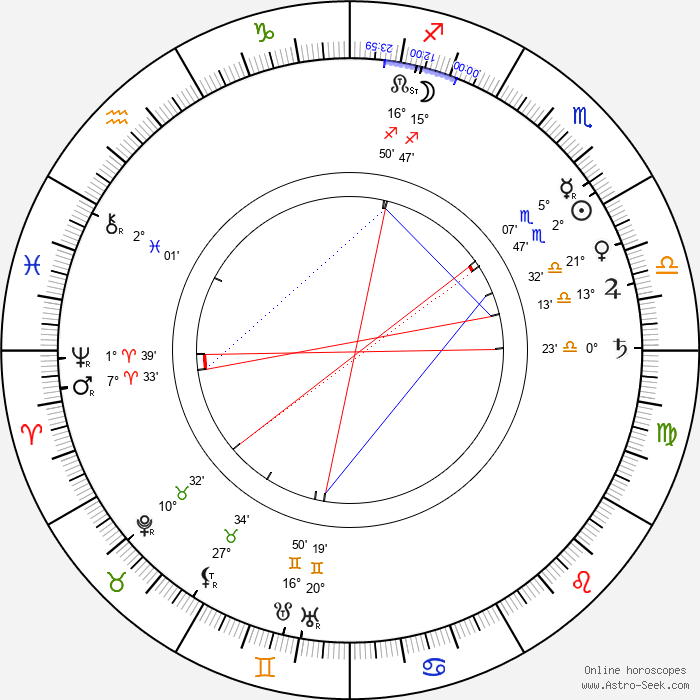
26 October 1862, Solna, Sweden (Rodden Rating X: No time of birth)
She spent her summers at the family's manor on the island of Adelsö in the lake called Mälaren. The natural beauty of the area left a lasting impression on her and would later become a source of inspiration in her work.
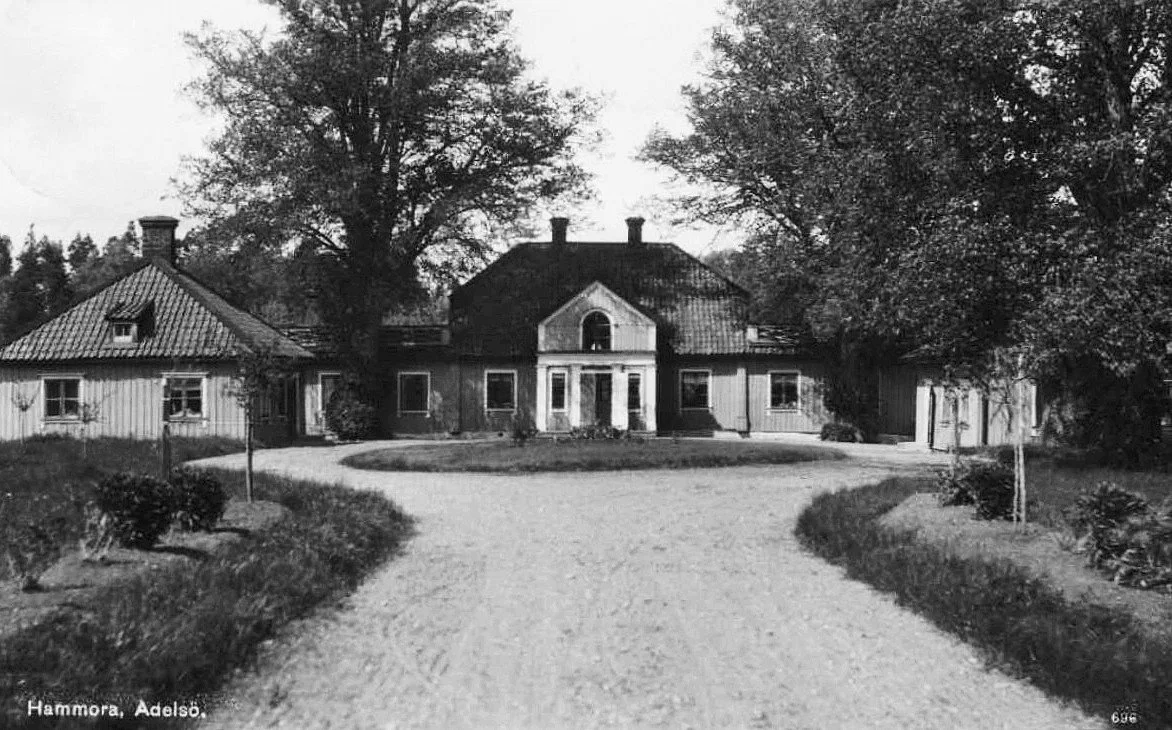
Hanmora, 1943
After the family moved to Stockholm, she studied at Tekniska skolan (or Technical School in English), which is now called Konstfack, where she learned to paint portraits and landscapes. She later attended Konstakademien (which is the Royal Academy of Fine Arts) for five years between 1882 and 1887. In other words, she had a solid art education behind her.

Hilma af Klint at the Royal Academy of Fine Arts, c. 1885
At the same time, interest in spirituality, esotericism, and the occult was growing across much of the Western world.
By 1879, af Klint had developed an interest and curiosity around the spiritual and occult, which grew rapidly following the death of her sister, Hermina, who died at the age of 10 in 1880. Hilma af Klint was 18 years old at the time.
Spiritualism was becoming increasingly popular across Northern Europe, and af Klint began participating in séances. These experiences would have a profound influence on her work for the rest of her life.
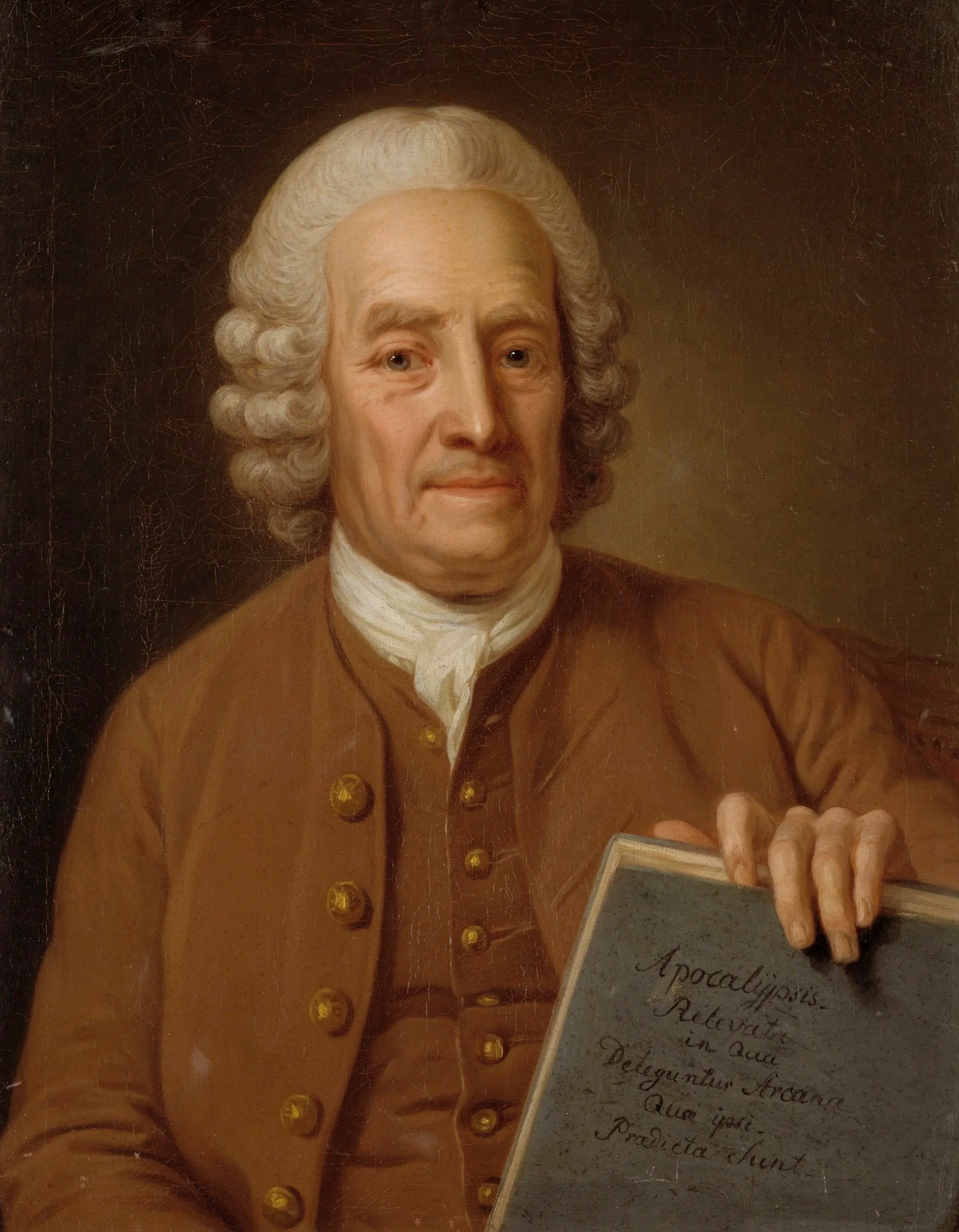
Emanuel Swedenborg, often attributed as being the father of spiritualism
Then, in 1889, the Swedish Theosophical Society was founded in Stockholm, influenced by early efforts from figures including the author Viktor Rydberg. Theosophy promoted ideas such as the unity of all life, a universal brotherhood of humanity, and the study of religion, philosophy, science, and the hidden laws of nature.
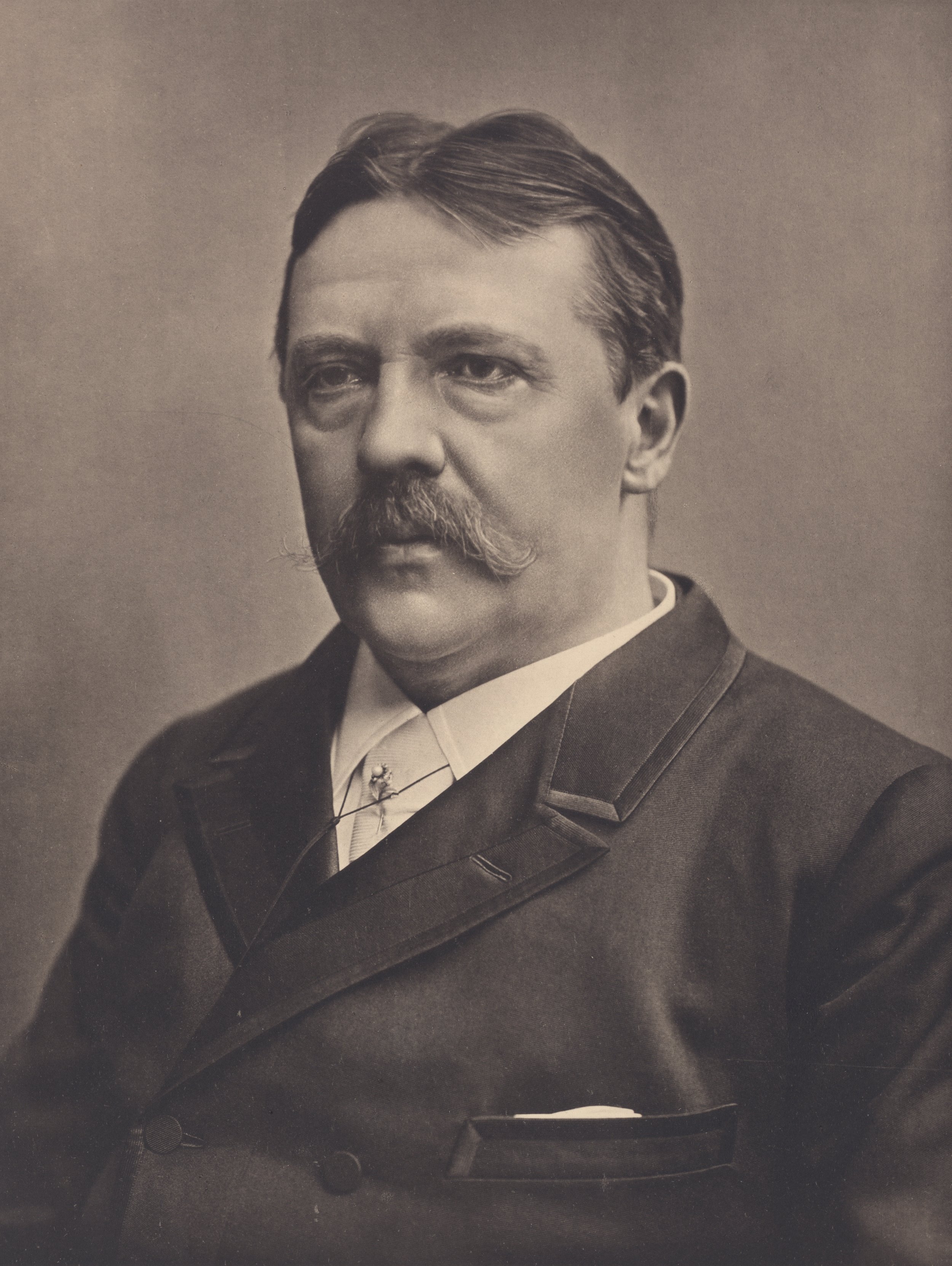
Viktor Rydberg, c. 1895
One of its most famous cofounders was Helena Blavatsky, who claimed to receive guidance from higher beings known as the Ascended Masters, who guided her in writing the books she did. As we'll see later, these ideas would also have a significant influence on af Klint's work.
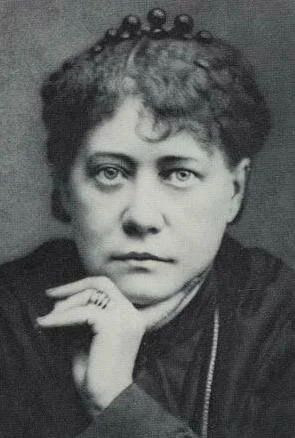
HP Blavatsky in 1877
However, another society had a huge impact on af Klint. Perhaps not so much because of the teachings and activities per se, but due to the women she met there.
The year was 1896, af Klint was in her 30s, and the society was called the Edelweiss Society, which embraced a combination of spiritualism and Helena Blavatsky’s teachings.
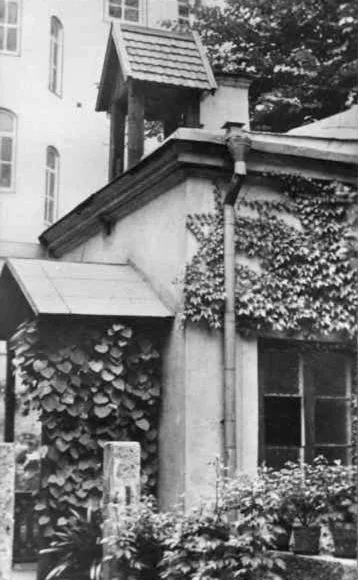
Edelweissförbundet’s (Edelweiss Society’s) chapel in Stockholm
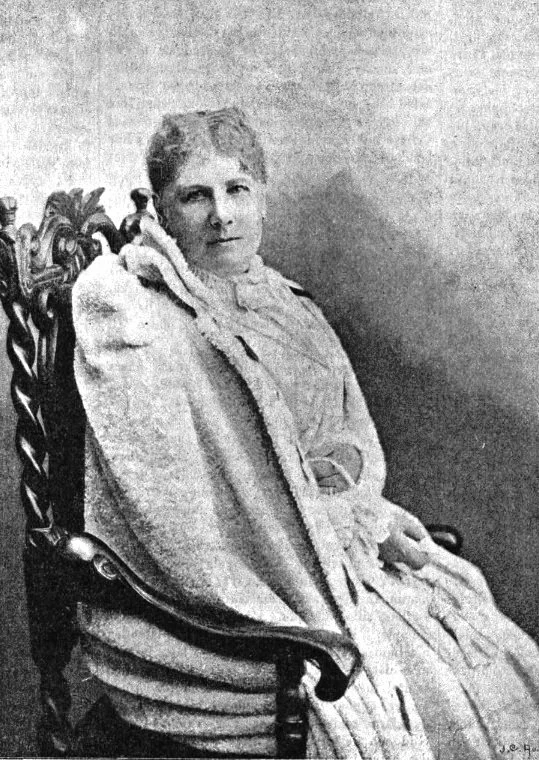
Huldine Beamish, Edelweissförbundets (Edelweiss Society’s) founder
af Klint was only a member for a short time, between 1896 and 1897, but there she met four like-minded women artists. Together, they would form the group they called De Fem (or The Five). This group would have a profound influence on her work, so I will come back to them later.
But first, I want to add some social context to her 20s and 30s.
Although the Royal Swedish Academy of Fine Arts had accepted women as students since 1864, they were still largely excluded from the male-dominated artistic circles that shaped careers and reputations.

Women students at Konstakademien (Royal Swedish Academy of Fine Arts), 1890

Women students at Konstakademien (Royal Swedish Academy of Fine Arts), 1890s
Af Klint herself came from a noble family with strong ties to the Swedish Navy, as at least her father and grandfather had both held high-ranking naval positions. Perhaps that made it easier for af Klint to focus on her art and gain opportunities that many women didn't have.
However, the general view male artists had of women at the time, and the overall view society had of women, was that they didn’t believe women could create anything new. The dominant belief was that women were only capable of reproducing or imitating what had already been done and existed. Women were, basically, only able to copy others, and things had already been made. Of course, as we will see with af Klint’s art, that was not true for her.
Around the same time as af Klint studied at and graduated from the Royal Swedish Academy of Fine Arts, some interesting scientific breakthroughs happened. Like the spiritual movements that were spreading across the continent, science was also beginning to explore realities that couldn't be seen with the naked eye.
In 1888, Heinrich Hertz successfully proved the existence of electromagnetic waves, which led to the invention of wireless telegraphy.
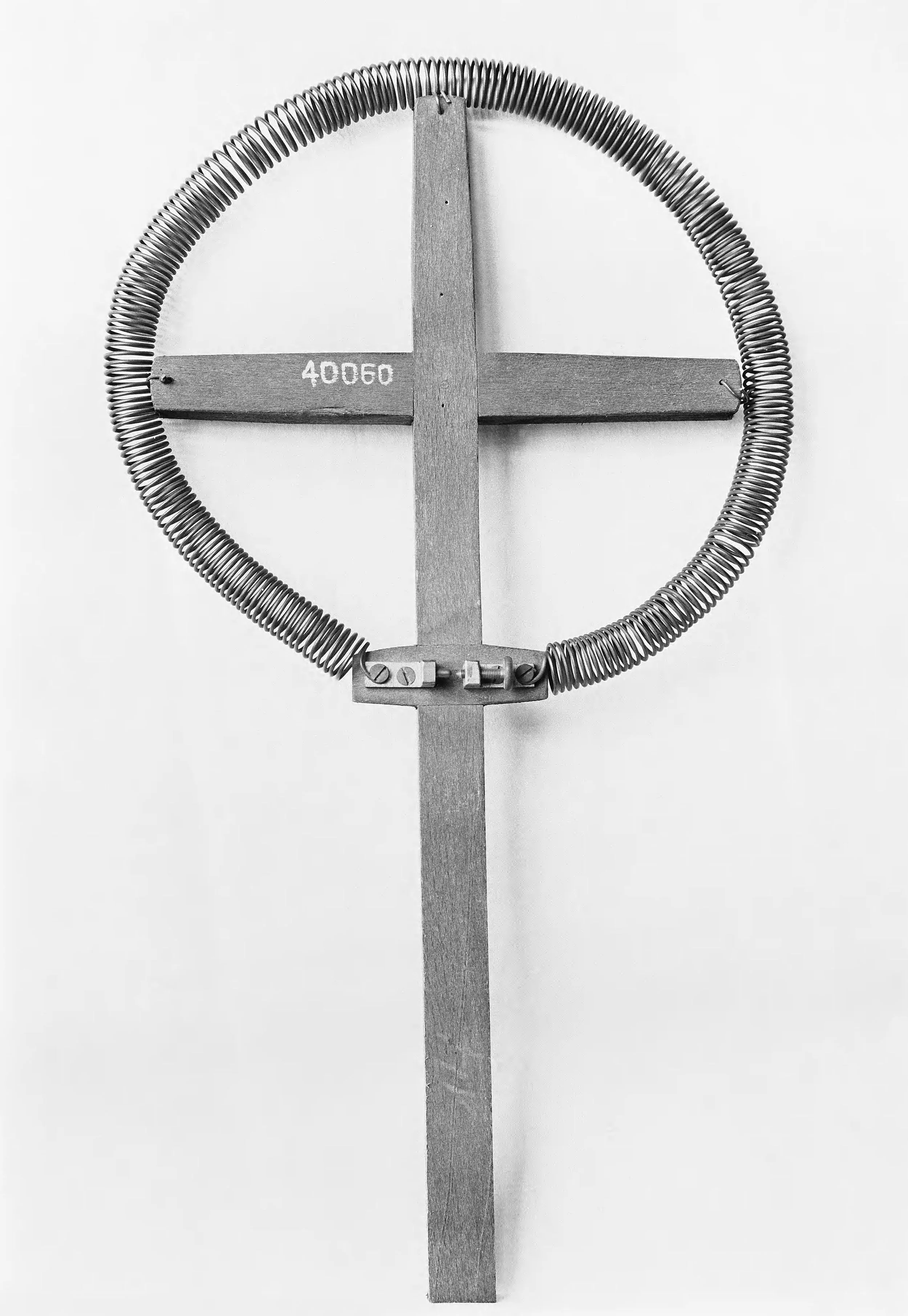
Resonator antenna used by Heinrich Hertz to demonstrate the existence of radio waves

Hertz's first radio transmitter
A few years later, in 1895, Wilhelm Röntgen discovered X-rays, making it possible to see beneath the surface of the human body without cutting it open.

Print of Wilhelm Röntgen's first "medical" X-ray, of his wife's hand, taken on 22 December 1895
Suddenly, invisible forces and hidden realities were becoming scientifically observable.
In a way, scientists and many early abstract artists were asking similar questions: What exists beyond what we can immediately see with our eyes?
For artists like Hilma af Klint, that question would become central to their work.
And, speaking of her work, let’s focus on that now.
Her Work and Legacy
Before we dive into af Klint's work, there's something important to understand about how she worked.
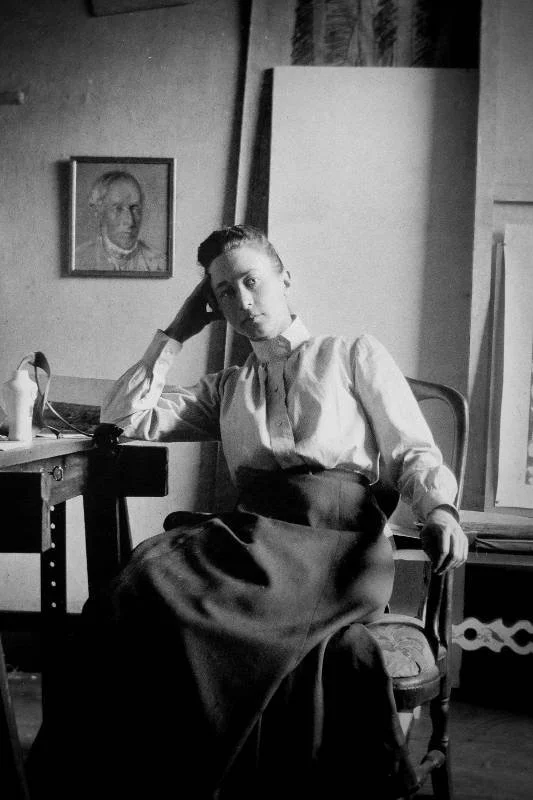
Hilma af Klint in her studio, c. 1895
She didn’t work on individual paintings as much as she did in series, and within those are groups and subgroups that explore the themes from different aspects and perspectives. It’s almost like a scientific system, moving between the vast cosmic scale and the microscopic scale to explore how everything is interconnected.
So, rather than focusing on individual paintings, I will approach her work from a series or group perspective, while giving you some examples of paintings within each group.
But first, let’s set the stage for the beginning of her artistic journey.
As I mentioned before, women weren’t really welcomed into the male-dominated artist circles of the time. So, af Klint did what any woman would’ve done and connected with other women instead. In fact, she mostly worked in women's circles because they supported her in ways that her male colleagues never would have.
This brings us back to the group of women she met at the Edelweiss Society. They were Anna Cassel, Cornelia Cederberg, Mathilda Nilsson, and Sigrid Hedman. And, as I mentioned before, they became known as The Five.
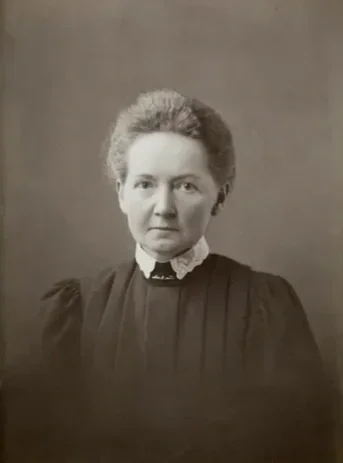
Anna Cassel (1860–1937)
For roughly ten years, from 1896 to 1907, they met every Friday to hold séances where they connected with higher levels of consciousness and performed different exercises, like automatic drawings. This 10-year period with The Five became a preparation period for af Klint’s later spiritually based abstract work.
Even after The Five disbanded in 1907, af Klint continued surrounding herself with women artists and companions. Among them were Anna Cassel (also a former member of The Five), Alma Arnell, and Lotten Rönquist, and Thomasine Andersson, who became especially close to her. The two lived together for many years until Andersson died in 1940, four years before af Klint herself passed away. I’m not saying that was code for lesbian lovers. But I’m also not saying that wasn’t the case.
Now, while af Klint is best known today for her abstract paintings, she actually began by painting landscapes and portraits in a naturalistic style, many of which are botanical studies in watercolor. These works provided her income throughout much of her life, along with the support she gained from her women friends, especially Anna Cassel.
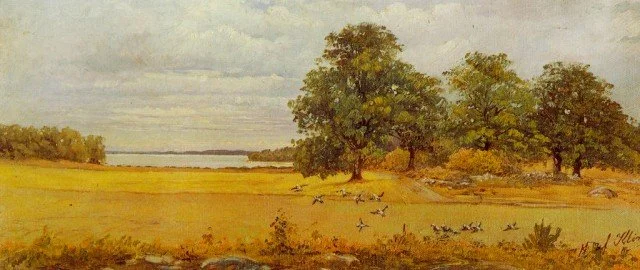
Eftersommar (Late Summer), an early naturalistic work, painted by af Klint in 1903
But it's her abstract work that fascinates me the most—and it's here that her esoteric and occult interests become impossible to separate from her art.
As I mentioned before, the decade with The Five became a preparatory period for her spiritually based artistry. The experimental automatic drawings she made while The Five was still an active group were made as early as 1896.
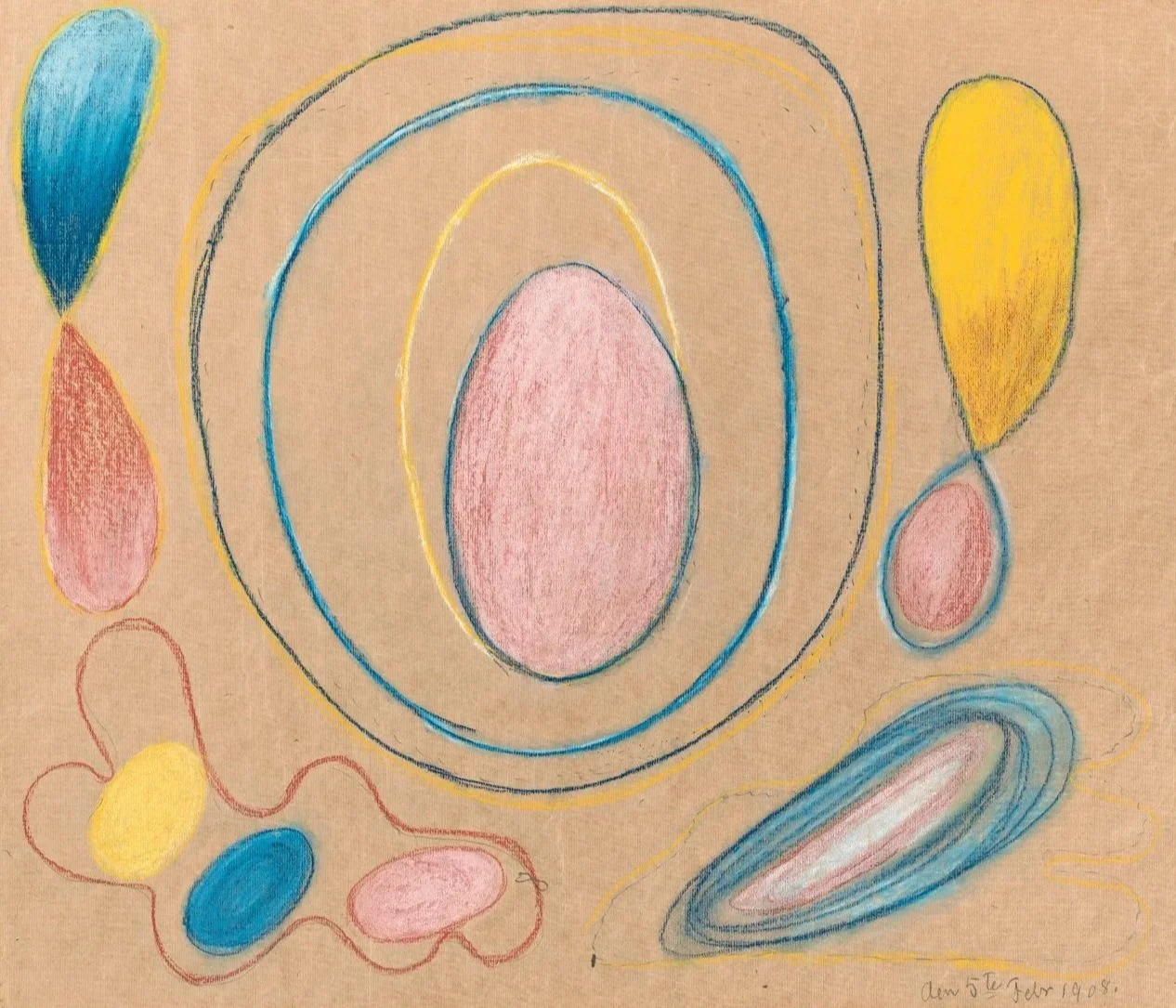
Automatic drawings by The Five, Untitled, Feb 5, 1908
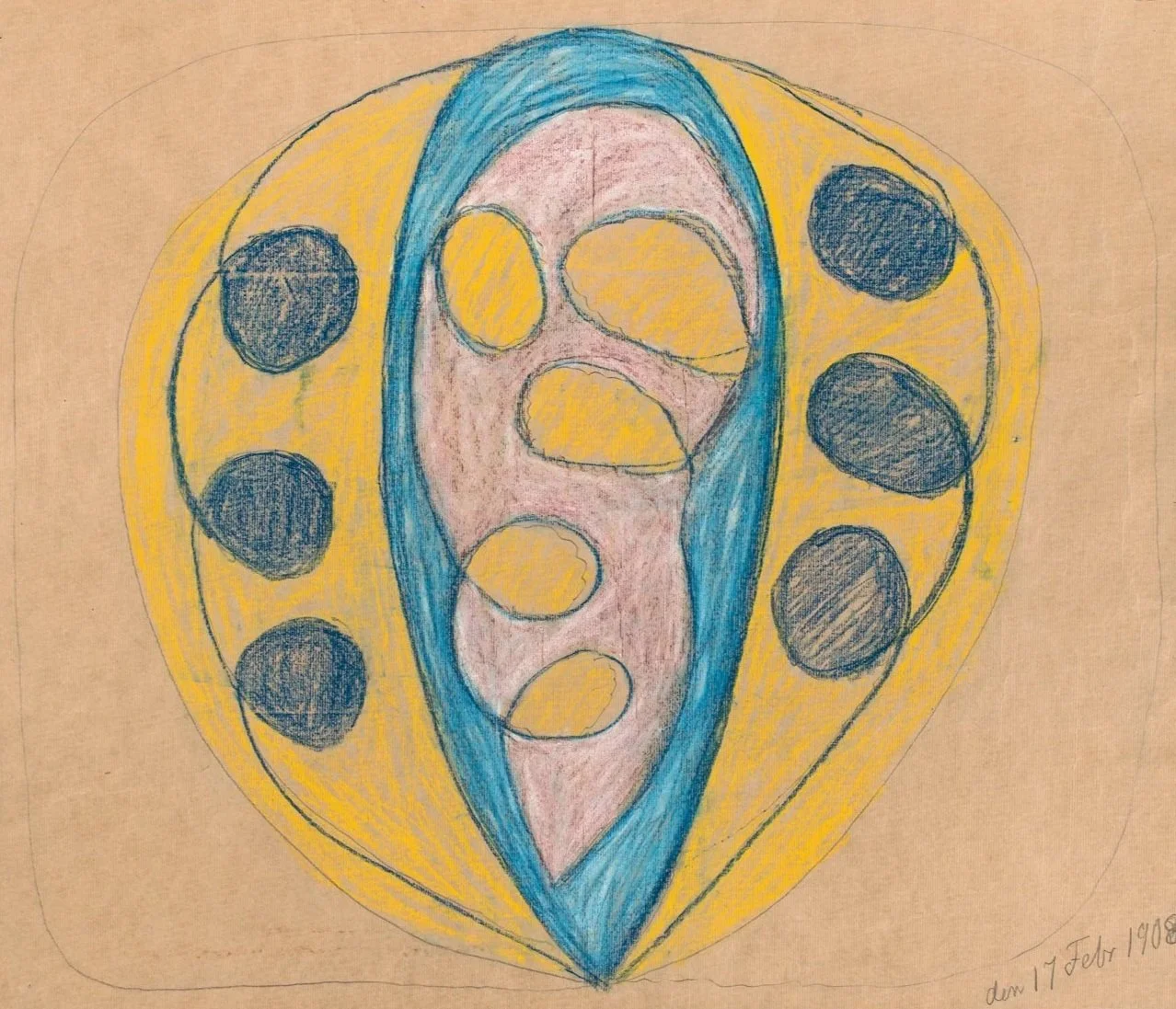
Automatic drawings by The Five, Untitled, Feb 5, 1908
However, one thing to note is that these drawings were usually not signed with names, only dates, and are often seen as collaborative pieces by the whole group rather than the individual artists in The Five.
Regardless, these drawings were the start of the geometric visual language associated with af Klint’s abstract work.
Then, in 1904, she had an otherworldly experience during a séance that would completely change the course of her artistic career.
She claimed to have heard a voice instructing her to create paintings from another dimension or astral plane to proclaim a new philosophy of life.
Two years later, she began doing exactly that.
In November 1906, af Klint began painting Målningarna till Templet (or The Paintings of the Temple), which is the monumental series of 193 works of art she created between 1906 and 1915. The first 111 paintings were completed in just eighteen months, between November 1906 and April 1908. Some of these paintings are large in size and measure approximately 240 cm wide and 320 cm high.
This project had her act as a medium to convey the messages and guidance of the forces she called De Höga (or the High Masters, which is another name for the Ascended Masters Helena Blavatsky was in contact with).
Two of these High Masters appear frequently in af Klint’s notebooks: Ananda and Amaliel. According to af Klint’s notes, Ananda spoke of “forntid” (which is basically translated to “prehistory”, but can also mean the distant past) while Amaliel spoke of “framtid” (which means the future). Ananda, I believe, was the first High Master af Klint connected to, and the first to encourage her to create this entirely new form of art.
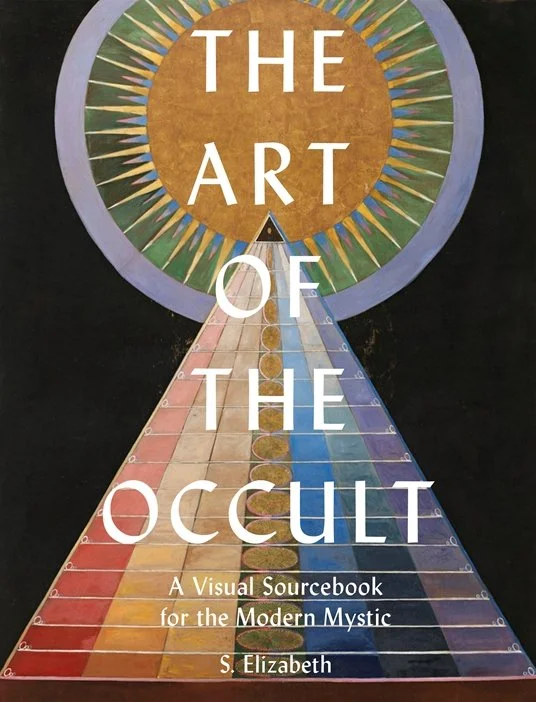
The Art of the Occult, book cover
In other words, S. Elizabeth, in the book The Art of the Occult, writes that Theosophy gave Hilma af Klint and the many other artists who became members or followed their teachings “a perspective that became the fundamental groundwork of their beliefs; from this vantage point, they believed they were able to see beyond the natural world into otherworldly realms. They stood in this doorway between worlds as messengers, and communicating this knowledge became the objective of their art” (Elizabeth, 2020, p. 127).
And that’s clearly visible in The Paintings for the Temple. So, let’s look at some of her artwork.
Let’s start with her first series of abstracts called WU/Rosen, painted between 1906 and 1907.
The first group was called Urkaos (or Primordial Chaos). They combine bold brushstrokes and symbolism, as well as geometric spirals that resemble the electromagnetic and radio waves that had been scientifically proven to exist around a decade before this.
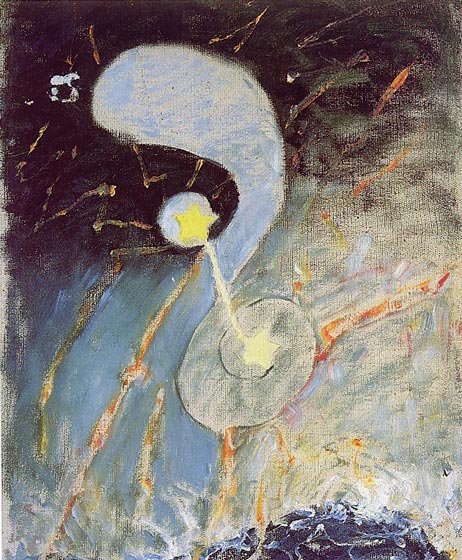
WU/Rosen, Group 1, Urkaos (Primordial Chaos), No. 2, 1906
These paintings also introduce one of af Klint's recurring themes: the relationship between feminine and masculine energies. Throughout much of her work, blue represents the feminine and yellow represents the masculine. Keep this in mind as we go through her works.
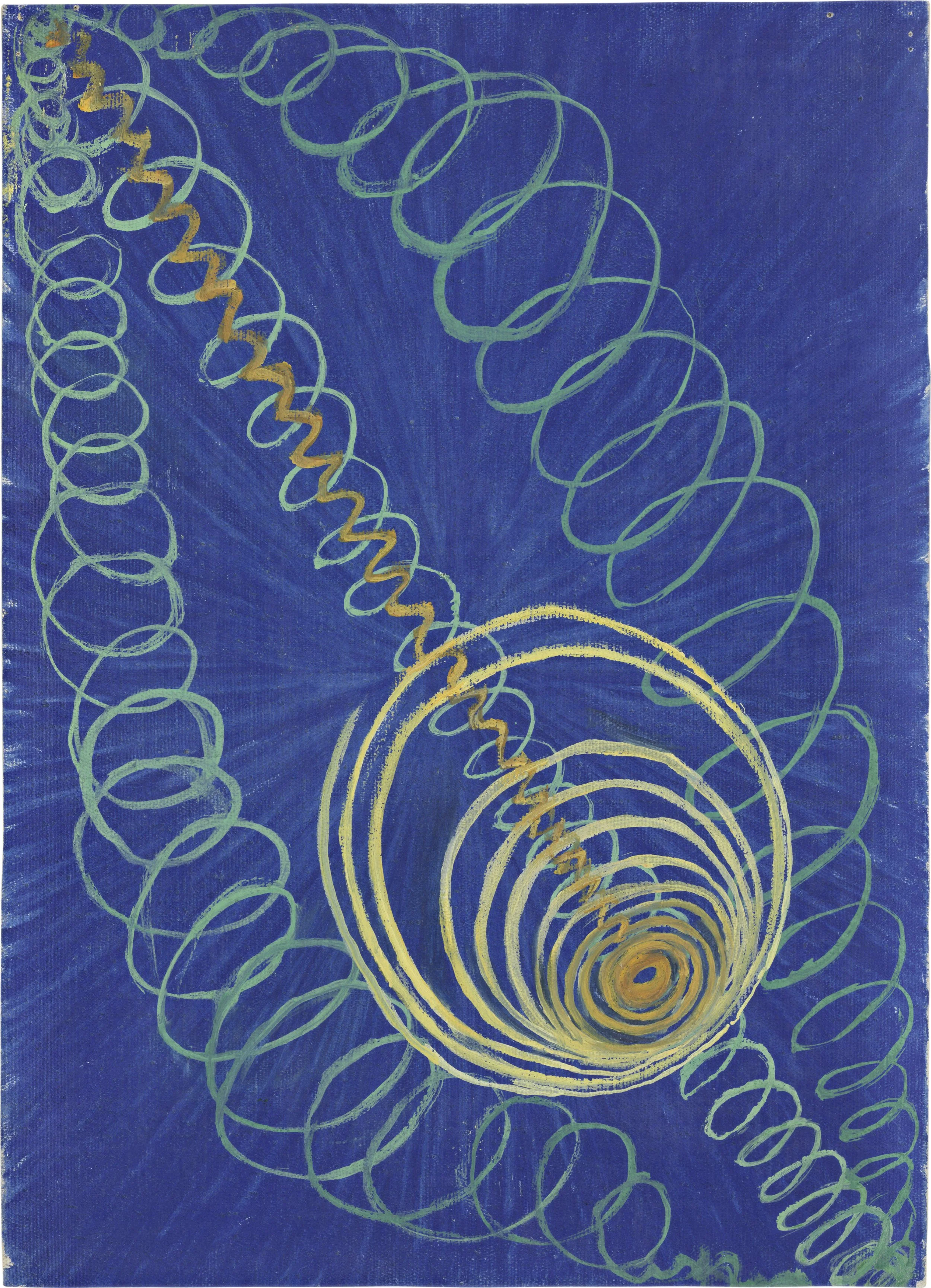
WU/Rosen, Group 1, Urkaos (Primordial Chaos), No. 2, 1906
In 1907, she also painted her largest works, called De Tio Största (or The Ten Largest).
These big, vividly colored works with organic shapes and swirling lines explore the different stages of human life, from childhood to old age.

De tio största (The Ten Largest), No. 1, Barnaåldern (Childhood) 1907

De tio största (The Ten Largest), No. 2, Barnaåldern (Childhood) 1907
What's remarkable is that all ten were completed between November and December of 1907, despite their enormous size and complexity. However, af Klint is believed to have received help from women in her circle, particularly Anna Cassel, whom she had been friends with since the days of The Five.

De tio största (The Ten Largest), No. 3, Ynglingaåldern (Youth), Grupp 4, 1907
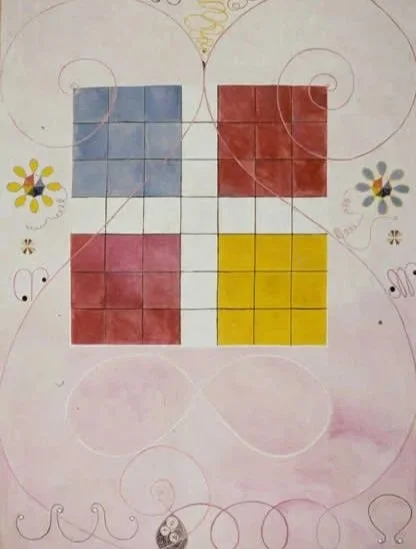
De tio största (The Ten Largest), No. 10 Ålderdomen (Old Age), Grupp 4, 1907
The following year, she began working with another recurring symbol: the seven-pointed star.
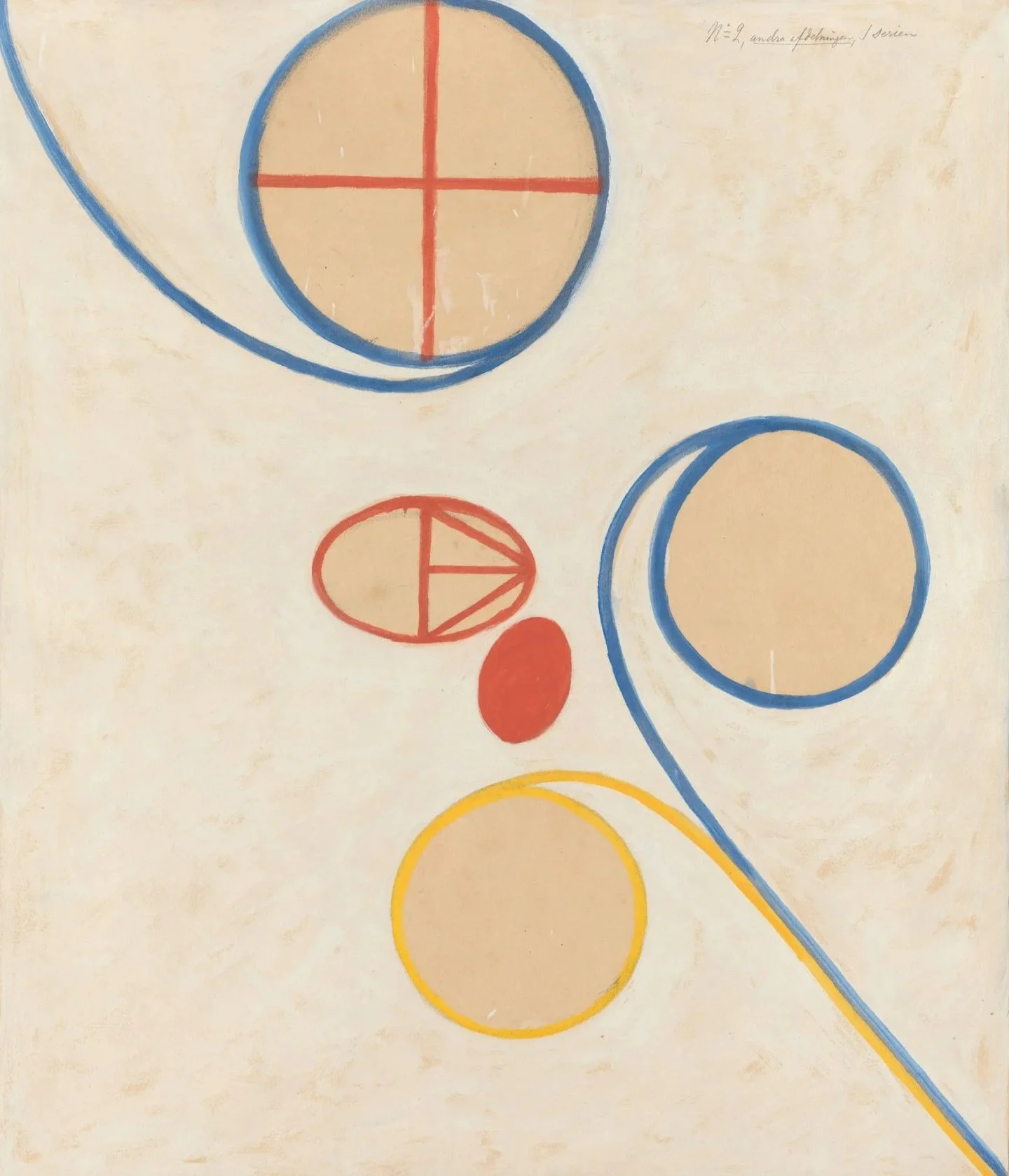
WUS/Sjustjärnan (The Seven-Pointed Star), Group 5, No. 2, 1908
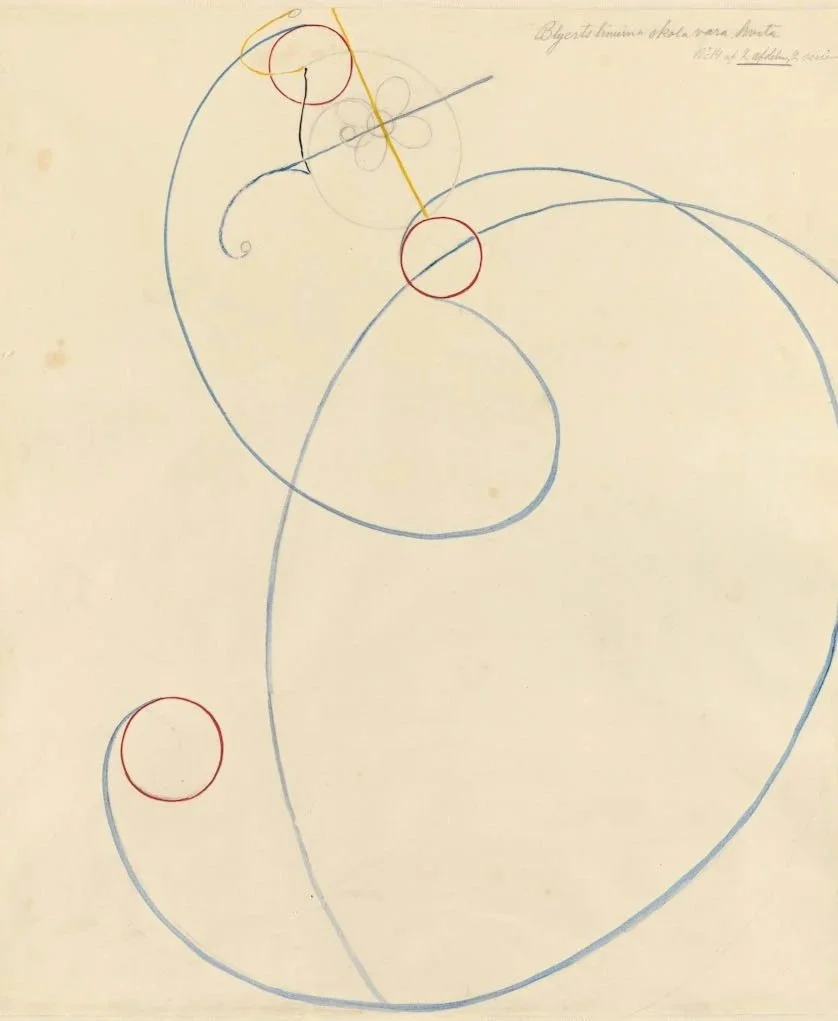
WUS/Sjustjärnan (The Seven-Pointed Star), Group 5, No. 14, 1908
The number seven is a sacred number that appears throughout religious and spiritual traditions and is often associated with divine order and the inner spiritual journey. In af Klint's work, I believe she was referring to the star cluster known as the Seven Stars, the Seven Sisters, or the Pleiades, which, in Theosophy, is believed to transmit spiritual energy that eventually reaches the human plane.
Then came a major interruption.
Between 1908 and 1912, af Klint took a nearly four-year break from painting after receiving harsh criticism from a Theosophist leader, Rudolf Steiner, whom she admired.
When she returned, however, she produced some of her most powerful work.
Between 1913 and 1915, she painted the series called Kunskapens Träd (or the Tree of Knowledge), where she depicts different spiritual planes of existence. Whether these paintings were influenced by the Kabbalistic Tree of Life is something I can only speculate about, but the symbolism of the tree of life or the cosmic tree appears across many of the world’s mythological, religious, and philosophical traditions.
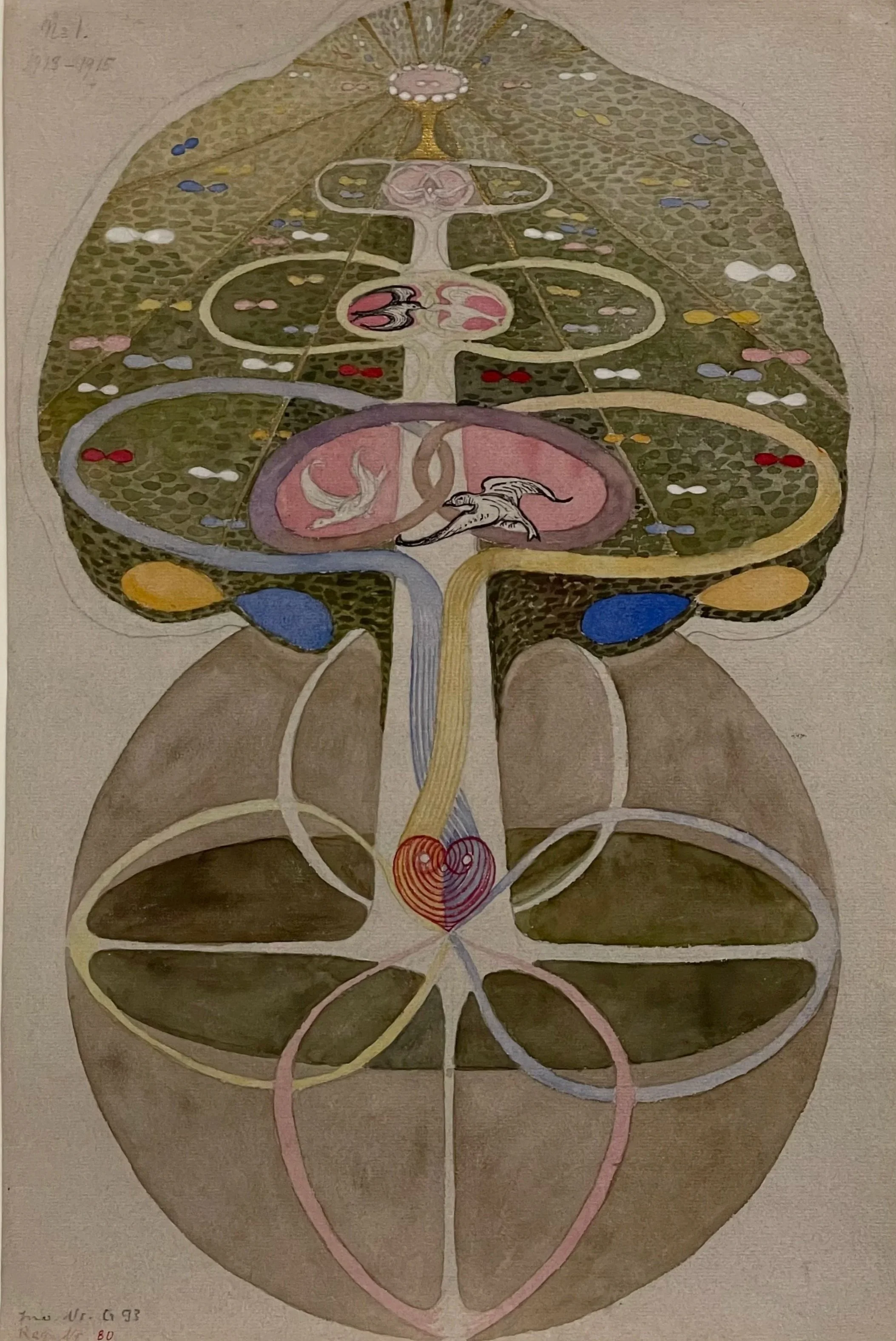
Kunskapens Träd (Tree of Knowledge), No. 1, 1913–1915
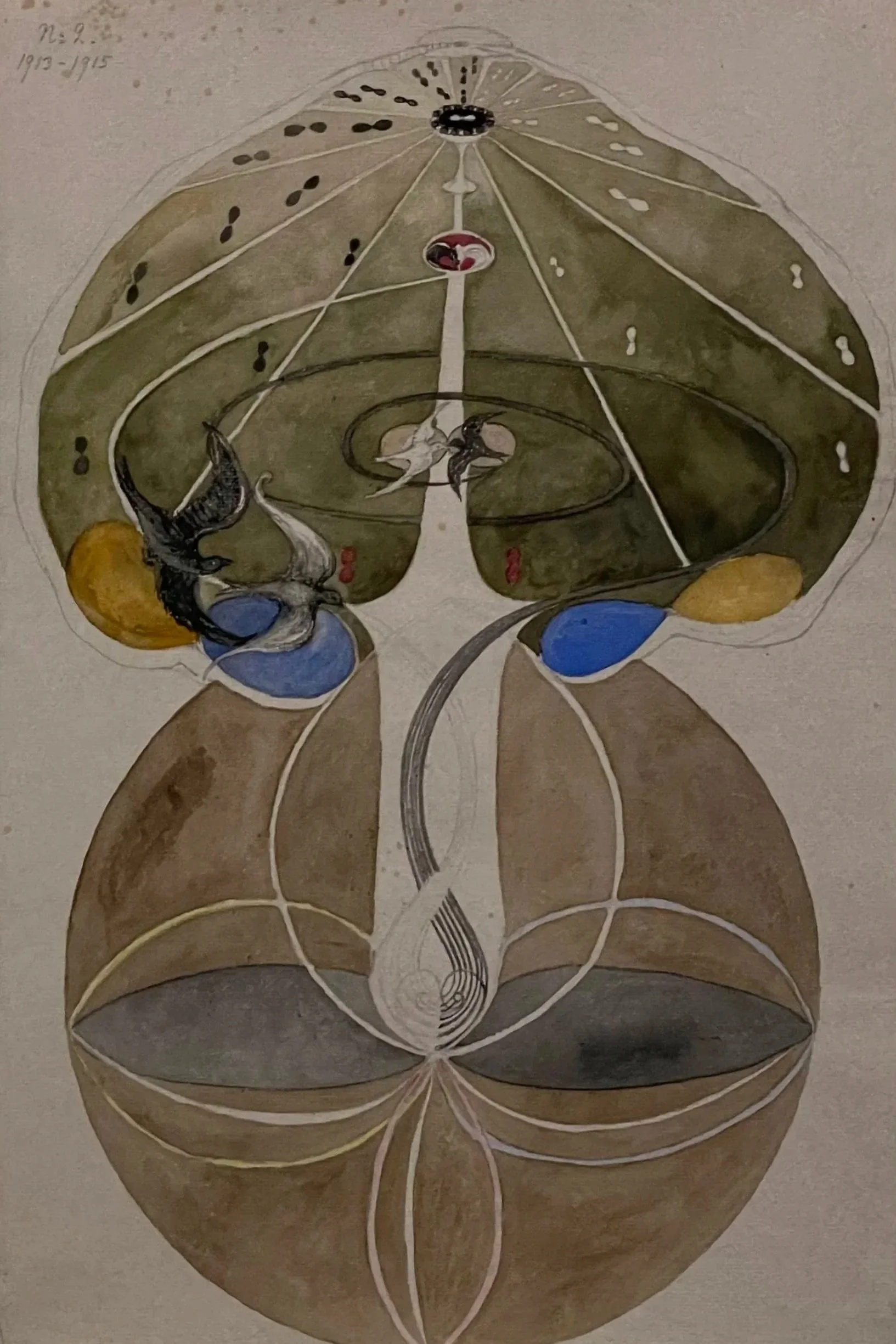
Kunskapens Träd (Tree of Knowledge), No. 2, 1913–1915
In 1915, she painted another iconic series: Svanen (or The Swan).
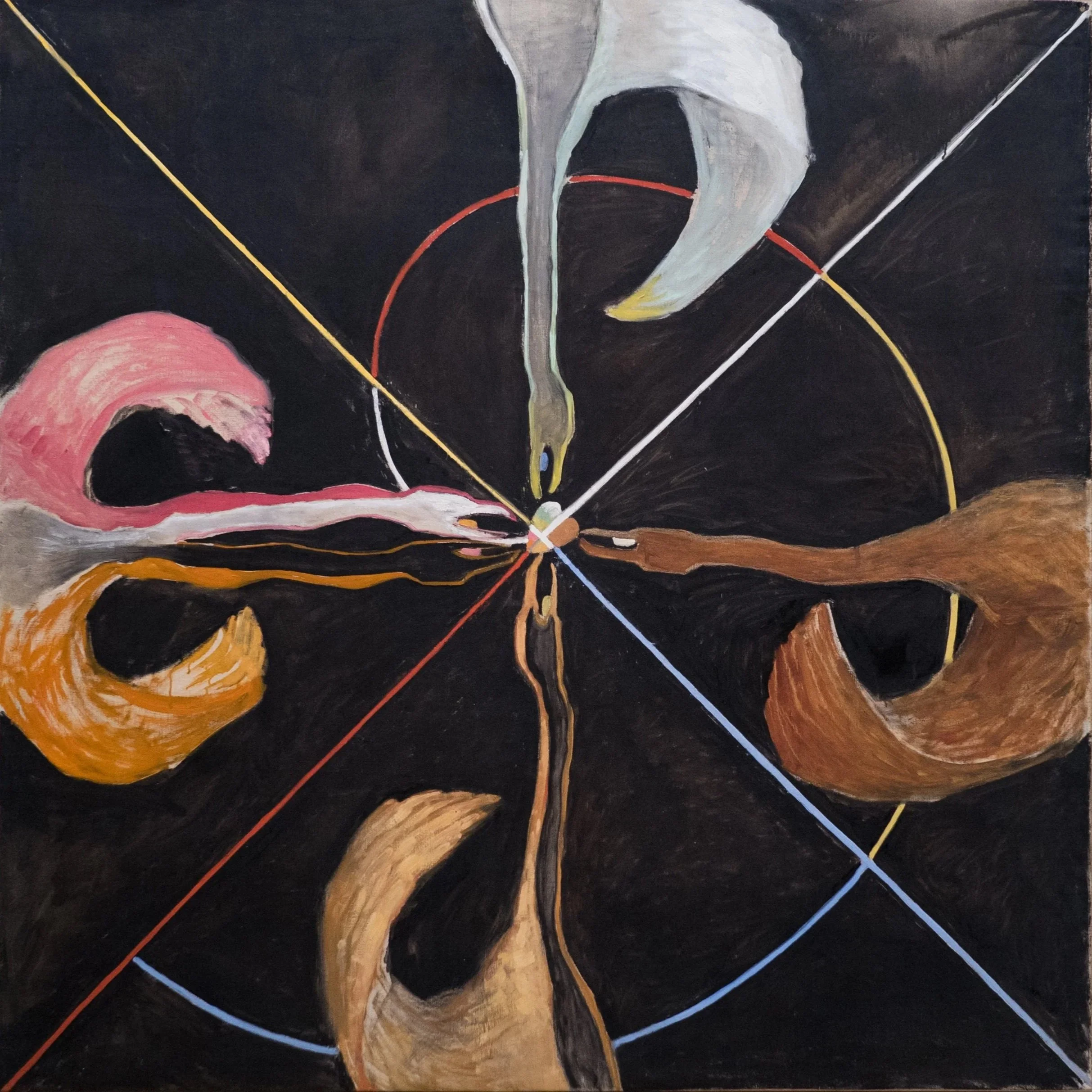
Group 9/SUW, Svanen (The Swan), No. 7, 1915
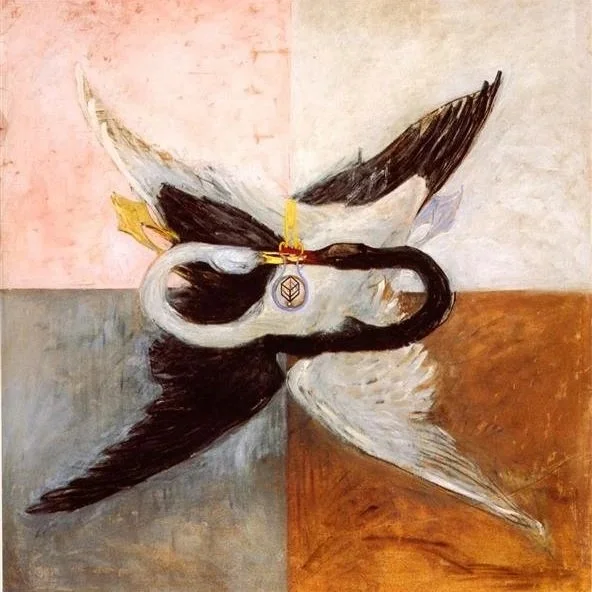
Group 9/SUW, Svanen (The Swan), No. 24, 1915
By this point, her style had become more geometric in nature, often dividing the image in two (either horizontally or vertically) and exploring dualities and opposites in, sometimes, very clear ways, where she might’ve been more subtle with it before.
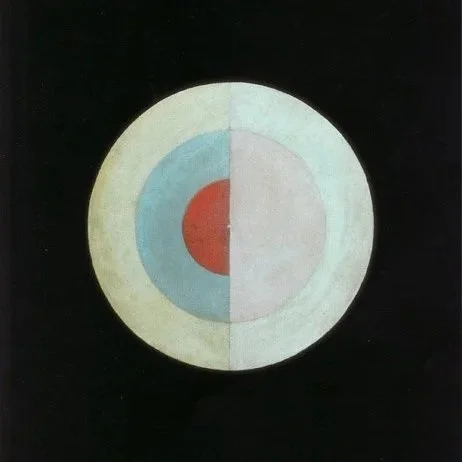
Group 9/SUW, Svanen (The Swan), No. 16, 1915

Group 9/SUW, Svanen (The Swan), No. 17, 1915
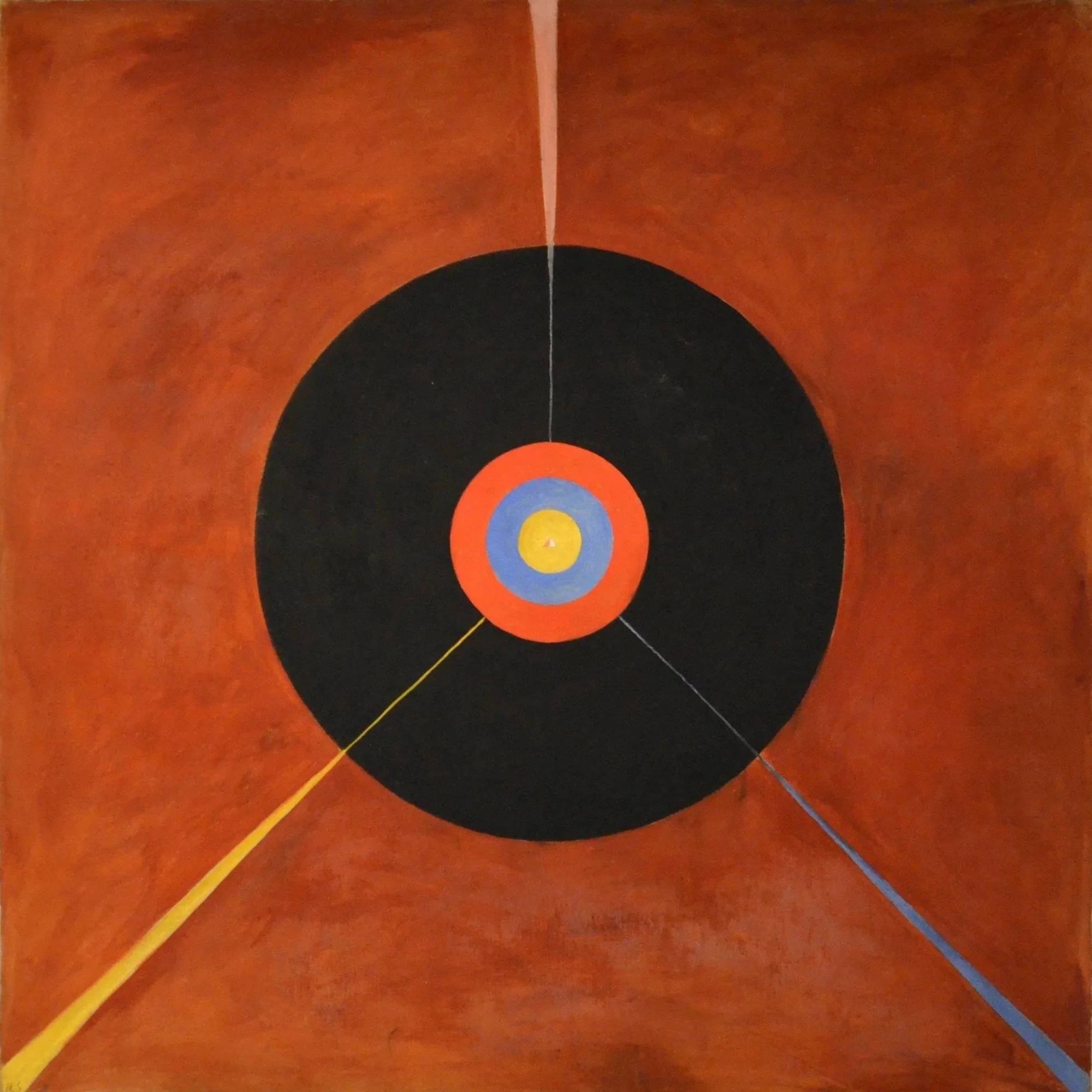
Group 9/SUW, Svanen (The Swan), No. 18, 1915
The contrasts between the black and white swans are perhaps the clearest example of this. Looking at them, I'm reminded of the yin and yang symbol. However, in contrast to the yin and yang, the white swan in af Klint’s painting represents the feminine while the black swan represents the masculine. We can see that in the use of the blue and yellow. As I mentioned before, af Klint used blue to represent the feminine and yellow to represent the masculine.
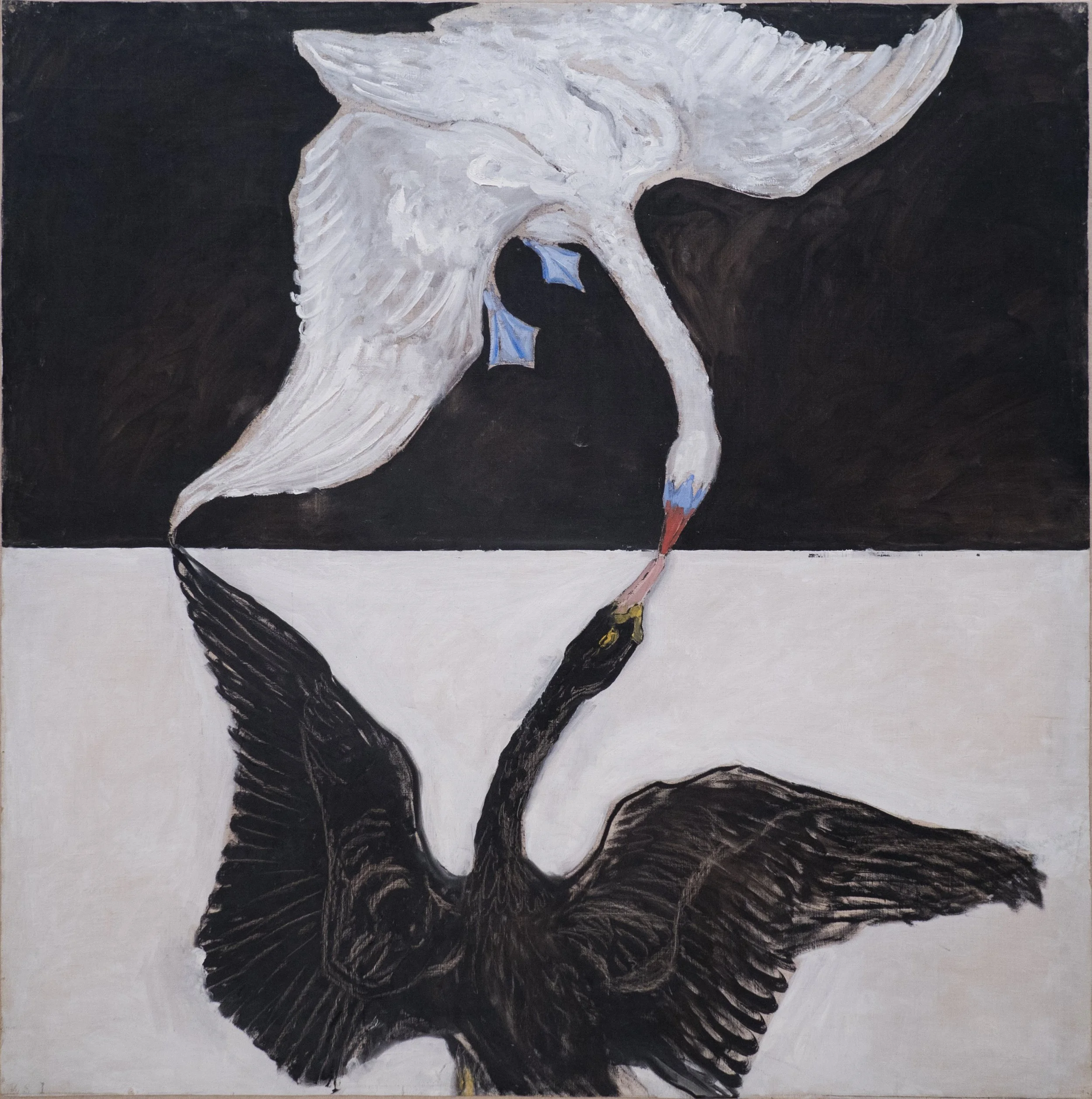
Group 9/SUW, Svanen (The Swan), No. 1, 1915
This geometric style would continue into her iconic Altarbilder (or Altarpieces), also from 1915. These three paintings depict, according to Moderna Museet, “the ascension from the material world back to unity (the triangle pointing to the golden circle) and the descension from divine unity into the diversity of the material world (the inverted triangle).”
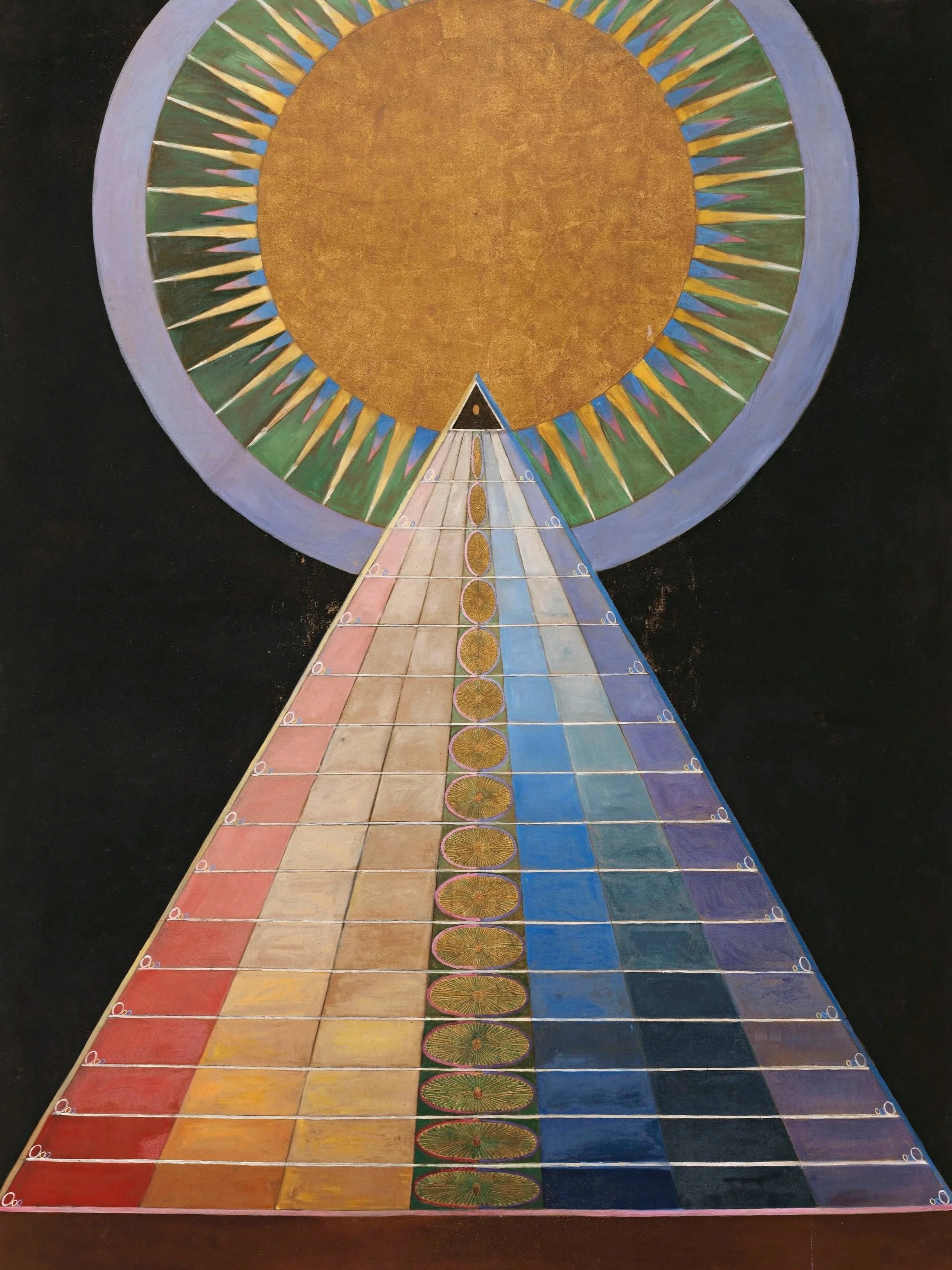
Group 10, No. 1, Altarbild (Altarpiece), 1915
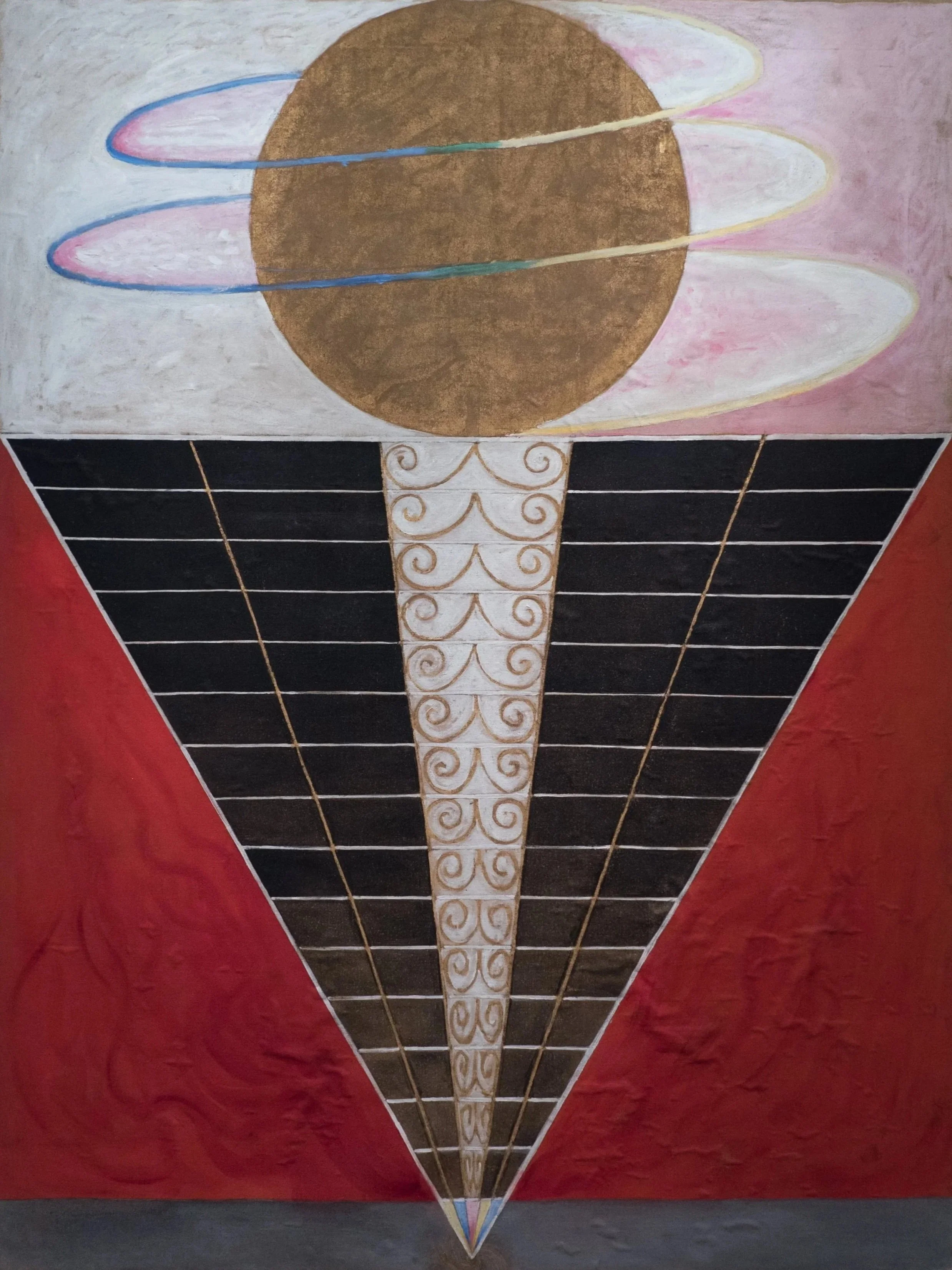
Group 10, No. 2, Altarbild (Altarpiece), 1915
The third painting, which I haven’t been able to access, depicts a golden circle with a small six-pointed star in the middle. Moderna Museet describes the meaning of it by writing that “a small six-pointed star within the large golden circle is an esoteric symbol for the universe.”
Although af Klint continued working after this period, a major change came after her mother's death in 1920. She moved to Helsingborg and largely stopped painting abstract oils. She spent the remainder of her life primarily painting small-format watercolors and writing in her notebooks, trying to make sense of all the things she’d been through in her artistic life and career.
Her many notebooks and diaries became a space for reflection, trying to understand the meaning of her art and the messages she’d received.
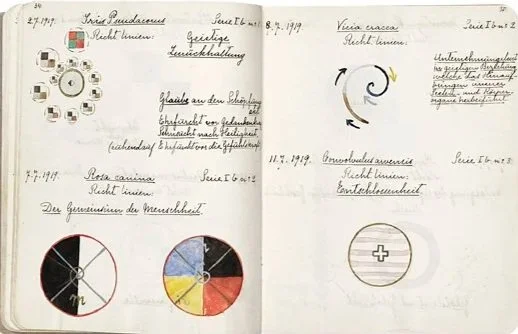
Notebook, 2–11 July 1919
Those notebooks also include her vision for how her Temple paintings should be displayed. She imagined them housed in a spiral-shaped temple. Visitors would gradually ascend a spiral staircase, moving through the paintings until they reached the top, where they could look into the universe. What a way to connect her paintings with their meaning, the universe.
And how fitting it was that her paintings were showcased at the Guggenheim in New York, a spiral-shaped building. That exhibition, held between October 2018 and April 2019, became the museum's most successful exhibition ever and introduced af Klint to a global audience.
Which raises an interesting question: If her work was so extraordinary, why did almost nobody know about it for decades?
The answer lies partly with af Klint herself.
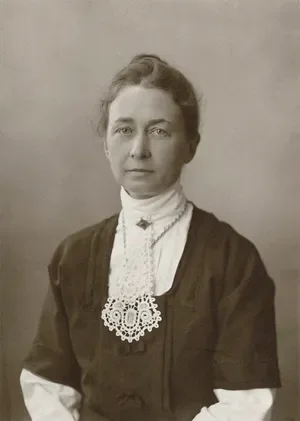
Hilma af Klint, c. 1910s
After struggling to exhibit her abstract paintings during her lifetime, she later in life changed her will to stipulate that her work would not be able to be viewed by the public until at least 20 years after her death.
She died on 21st October 1944 in Danderyd, and when the boxes containing her works were opened at the end of the 1960s, very few people had seen or knew of her work.
What they discovered was astonishing. Around 1300 paintings, 124 notebooks and diaries, and over 26,000 hand and machine-written pages behind.
So, how would I summarize her art?
At its core, I would say that her art is about how we are living in a binary or polarized world where everything is either/or. It’s either day or night, we are either good or bad, or women or men, etc. That’s how our world is built.
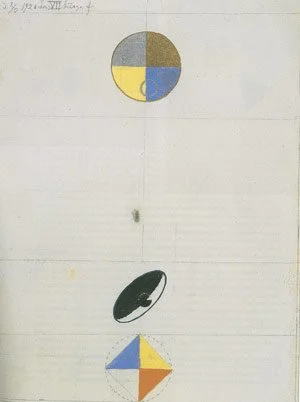
Series 7, No. 3f, 1920
But I feel like she didn’t believe those opposites were truly separate. Beneath all the divisions we create, she saw unity. A reality where everything is interconnected, where the boundaries between things dissolve, and where all life is part of a larger whole.
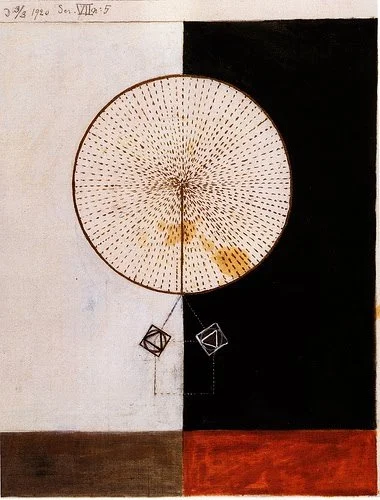
Series 7, No. 5, 1920
For me, that's one of the central messages running through her work.
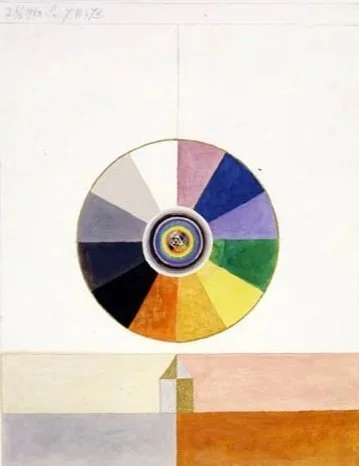
Series 7, No. 7d, 1920
Many people say Hilma af Klint created art for the future because her ideas feel so relevant today.
I don’t necessarily agree with that idea, though. I think the message was just as important in her own time. The World Wars are a testament to that.
Perhaps it was just that we, as in the human race, were too ignorant for them or weren’t ready.
And now, in a world where more and more people are searching for meaning, connection, and a sense of something larger than themselves, maybe we're finally willing to be open to her message.
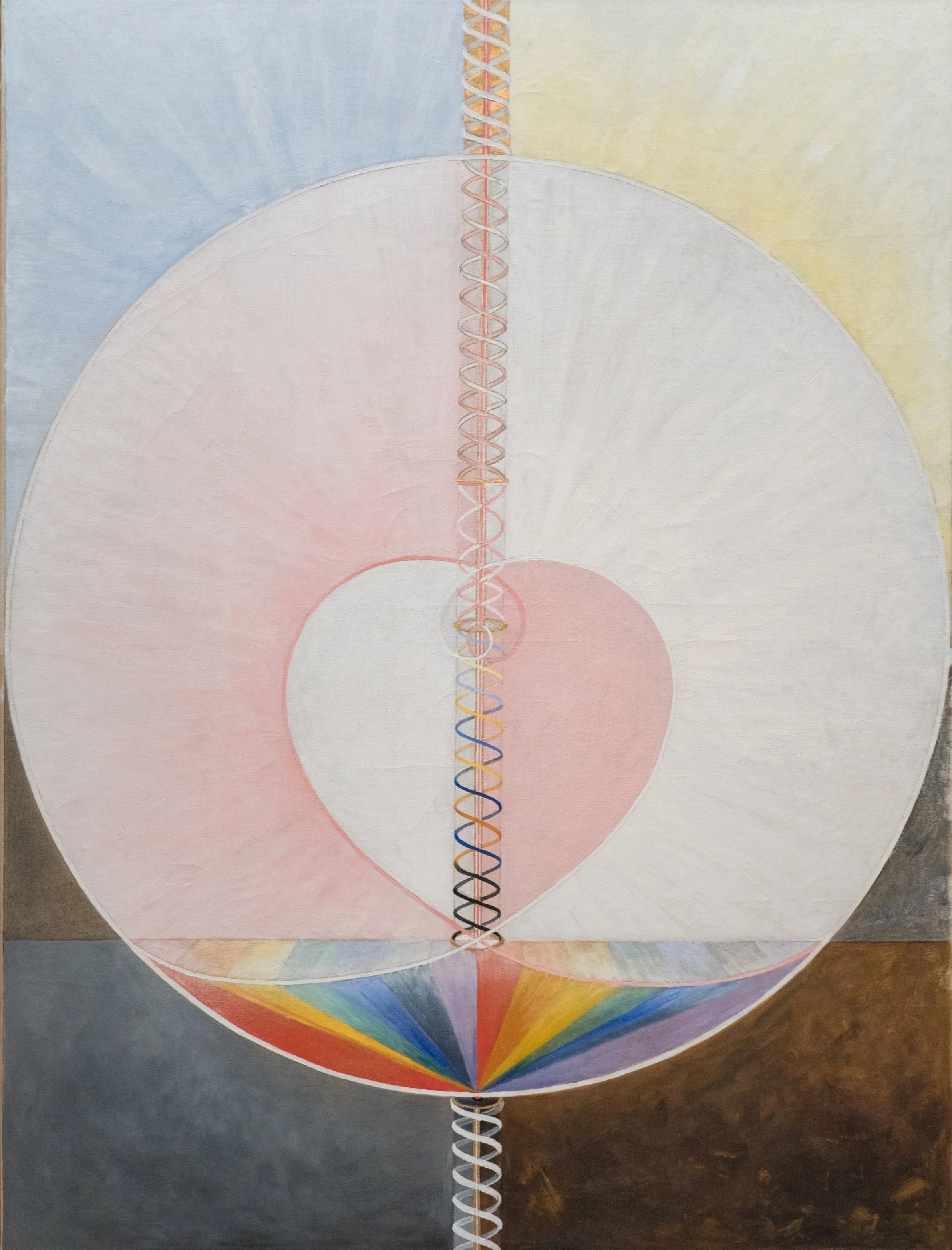
Group 9/UW, No. 25, The Dove, No. 1, 1915
I know I am.
So with all of that said, what do you think about Hilma af Klint, her work, and her legacy? Share your thoughts in the comments below.
If you want early access to my posts, as well as additional content, join my Patreon.
Sources
“Hilma af Klint”, Wikipedia. https://en.wikipedia.org/wiki/Hilma_af_Klint#Spiritual_and_philosophical_ideas (Accessed: 2026-05-10).
“In-depth Hilma af Klint”, Moderna Museet, https://www.modernamuseet.se/en/malmo/exhibitions/hilma-af-klint/in-depth/ (Accessed 2026-06-09)
Cheshes, Jay. “A Swirl of Intrigue Surrounds Swedish Painter Hilma af Klint’s Newfound Status as an Icon of Abstract Art”, Smithsonian magazine, April/May 2025. https://www.smithsonianmag.com/arts-culture/hilma-af-klint-intrigue-swedish-painter-abstract-art-icon-180986229/ (Accessed: 2026-05-10).
Elizabeth, S. The Art of the Occult: A Visual Sourcebook for the Modern Mystic. London: Frances Lincoln, 2020.
Images
Anna Cassel (1860–1937). Foto: G Hertzberg, DN, https://www.dn.se/kultur/anna-cassels-betydelse-for-hilma-af-klint-klargors/ (Accessed 2026-06-09)
Atom Series, No. 8, 1917. Public Domain, https://www.wikiart.org/en/hilma-af-klint/the-ten-largest-1907 (Accessed 2026-05-19)
Automatic drawings by The Five, Untitled, Feb 5, 1908. Photo: Moderna Museet, accessed on Art Gallery of NSW https://www.artgallery.nsw.gov.au/artboards/hilma/the-five/ (Accessed 2026-05-19)
Automatic drawings by The Five, Untitled, Feb 17, 1908. Photo: Moderna Museet, accessed on Art Gallery of NSW https://www.artgallery.nsw.gov.au/artboards/hilma/the-five/ (Accessed 2026-05-19)
De tio största (The Ten Largest), No. 1, Barnaåldern (Childhood) 1907. Public Domain, https://www.wikiart.org/en/hilma-af-klint/the-ten-largest-1907 (Accessed 2026-05-19)
De tio största (The Ten Largest), No. 2, Barnaåldern (Childhood) 1907. Public Domain, https://www.wikiart.org/en/hilma-af-klint/de-tio-st-rsta-n-2-barnaaldern-1907 (Accessed 2026-05-19)
De tio största (The Ten Largest), No. 3, Ynglingaåldern (Youth), Grupp 4, 1907. Av Hilma af Klint - http://www.kunstkritikk.no/kritikk/hilma-af-klint-diagram-artist/, Public Domain, https://commons.wikimedia.org/w/index.php?curid=38482154 (Accessed 2026-05-19)
De tio största (The Ten Largest), No. 10 Ålderdomen (Old Age), Grupp 4, 1907. Av Hilma af Klint - http://www.wikiart.org/en/hilma-af-klint/mode/all-paintings, Public Domain, https://commons.wikimedia.org/w/index.php?curid=38483297 (Accessed 2026-05-19)
Edelweissförbundet’s (Edelweiss Society’s) chapel in Stockholm. By unknown - Riksantikvarieämbetet, image no 14162-001.TIF, archive reference K 1 C: 613 E - F, CC0, https://commons.wikimedia.org/w/index.php?curid=42674467 (Accessed 2026-06-09)
Eftersommar (Late Summer) an early naturalistic work, painted by af Klint in 1903. By Hilma af Klint - https://lasottilelineadombra.com/2020/03/18/hilma-af-klint-storia-pioniera-astrattismo/, Public Domain, https://commons.wikimedia.org/w/index.php?curid=47144596 (Accessed 2026-05-19)
Emanuel Swedenborg. Attributed to Per Krafft the Elder - Nationalmuseum, Public Domain, https://commons.wikimedia.org/w/index.php?curid=52131693 (Accessed 2026-06-09)
Group 6, Evolution, No. 13, 1908. By Rhododendrites - Own work, Public Domain, https://commons.wikimedia.org/w/index.php?curid=79024204 (Accessed 2026-05-19)
Group 6, Evolution, No. 15, The Seven-Pointed Star Series. Public Domain, https://www.wikiart.org/en/hilma-af-klint/untitled-3 (Accessed 2026-05-19)
Group 9/SUW, Svanen (The Swan), No. 1, 1915. By Rhododendrites - Own work, Public Domain, https://commons.wikimedia.org/w/index.php?curid=79024201 (Accessed 2026-05-19)
Group 9/SUW, Svanen (The Swan), No. 7, 1915. By Rhododendrites - Own work, Public Domain, https://commons.wikimedia.org/w/index.php?curid=79024202 (Accessed 2026-05-19)
Group 9/SUW, Svanen (The Swan), No. 9, 1915. By Rhododendrites - Own work, Public Domain, https://commons.wikimedia.org/w/index.php?curid=79024198 (Accessed 2026-05-19)
Group 9/SUW, Svanen (The Swan), No. 10, 1915. By Rhododendrites - Own work, Public Domain, https://commons.wikimedia.org/w/index.php?curid=79024207 (Accessed 2026-05-19)
Group 9/SUW, Svanen (The Swan), No. 12, 1915. By Rhododendrites - Own work, Public Domain, https://commons.wikimedia.org/w/index.php?curid=79024206 (Accessed 2026-05-19)
Group 9/SUW, Svanen (The Swan), No. 16, 1915. By Hilma af Klint - http://www.wikiart.org/en/hilma-af-klint/mode/all-paintings, Public Domain, https://commons.wikimedia.org/w/index.php?curid=38483304 (Accessed 2026-05-19)
Group 9/SUW, Svanen (The Swan), No. 17, October 1914 – March 1915. By Hilma af Klint - [1], Public Domain, https://commons.wikimedia.org/w/index.php?curid=75296591 (Accessed 2026-05-19)
Group 9/SUW, Svanen (The Swan), No. 18, 1915. By Hilma af Klint - https://www.flickr.com/photos/doc_ing/13198506083/, Public Domain, https://commons.wikimedia.org/w/index.php?curid=38518720 (Accessed 2026-05-19)
Group 9/SUW, Svanen (The Swan), No. 24, 1915. Public Domain, https://www.wikiart.org/en/hilma-af-klint/svanen-1914 (Accessed 2026-05-19)
Group 9/UW, No. 12, Duvan (The Dove), 1915. Public Domain, https://www.wikiart.org/en/hilma-af-klint/the-dove-nr-12-1915 (Accessed 2026-05-19)
Group 9/UW, No. 25, Duvan (The Dove), No. 1, 1915. By Rhododendrites - Own work, Public Domain, https://commons.wikimedia.org/w/index.php?curid=79024203 (Accessed 2026-05-19)
Group 10, Altarbild (Altarpiece), No. 1, 1915. By Hilma af Klint - http://www.kunstkritikk.no/kritikk/hilma-af-klint-diagram-artist/, Public Domain, https://commons.wikimedia.org/w/index.php?curid=38482152 (Accessed 2026-05-19)
Group 10, Altarbild (Altarpiece), No. 2, 1915. By Rhododendrites - Own work, Public Domain, https://commons.wikimedia.org/w/index.php?curid=79024200 (Accessed 2026-05-19)
Hanmora, 1943. By unknown - older postcard, Public Domain, https://commons.wikimedia.org/w/index.php?curid=51174586 (Accessed 2026-06-09)
Hertz's first radio transmitter. By Rollo Appleyard - Retrieved December 30, 2014 from Rollo Appleyard, "Pioneers of Electrical Communication 5: Heinrich Rudolf Hertz" in Electrical Communication magazine, International Standard Electric Corp., New York, Vol. 6, No. 2, October 1927, p. 66, fig. 3 on http://www.americanradiohistory.com, Public Domain, https://commons.wikimedia.org/w/index.php?curid=37579879 (Accessed 2026-06-09)
Hilma af Klint at the Royal Academy of Fine Arts, c. 1885. Moderna Museet, https://www.modernamuseet.se/en/stockholm/exhibitions/hilma-af-klint-2013/about-the-artist/ (Accessed 2026-06-09)
Hilma af Klint, c. 1910s. Fine Art Images/Heritage Images—Hulton Archive/Getty Images, Encyclopædia Britannica, https://www.britannica.com/biography/Hilma-af-Klint (Accessed 2026-06-15)
Hilma af Klint in her studio, c. 1895. By Anonymous - http://www.sydsvenskan.se/Images2/2014/3/7/ELAklint08.jpg, Public Domain, https://commons.wikimedia.org/w/index.php?curid=34820236 (Accessed 2026-05-19)
Hilma af Klint, portrait by an unknown photographer. Moderna Museet, Public Domain, https://commons.wikimedia.org/w/index.php?curid=75296671 (Accessed 2026-05-19)
Hilma af Klint self-portrait. By Hilma af Klint – http://www.oh-nena.com/blog/2013/08/women-artists-hilma-af-klint/, Public Domain, https://commons.wikimedia.org/w/index.php?curid=38483479 (Accessed 2026-06-09)
HP Blavatsky in 1877. By Unsure - http://www.blavatskyarchives.com/hpbphotos6.htm, Public Domain, https://commons.wikimedia.org/w/index.php?curid=66334 (Accessed 2026-05-18)
Huldine Beamish, Edelweissförbundets (Edelweiss Society’s) founder. By unknown - Tidningen IDUN, no 3, 1893, Public Domain, https://commons.wikimedia.org/w/index.php?curid=42674859 (Accessed 2026-06-09)
Konstakademien, 2024. By Frankie Fouganthin - Eget arbete, CC BY 4.0, https://commons.wikimedia.org/w/index.php?curid=148827371 (Accessed 2026-06-09)
Konstfacks old facilities by Valhallavägen. By Arild Vågen - Eget arbete, CC BY-SA 3.0, https://commons.wikimedia.org/w/index.php?curid=18087991 (Accessed 2026-06-09)
Kunskapens Träd (Tree of Knowledge), No. 1, 1913–1915. By Hilma af Klint - 19h00s, Public Domain, https://commons.wikimedia.org/w/index.php?curid=141388015 (Accessed 2026-05-19)
Kunskapens Träd (Tree of Knowledge), No. 2, 1913–1915. By Hilma af Klint - 19h00s, Public Domain, https://commons.wikimedia.org/w/index.php?curid=143032824 (Accessed 2026-05-19)
Series 2, No. 2a Mahatmernas nuvarande ståndpunkt (The Mahatmas Present Standing Point), 1920. Public Domain, https://www.wikiart.org/en/hilma-af-klint/the-mahatmas-present-standing-point-series-ii-no-2a-1920 (Accessed 2026-05-19)
Notebook, 2–11 July 1919. By Hilma af Klint - http://www.oh-nena.com/blog/2013/08/women-artists-hilma-af-klint/, Public Domain, https://commons.wikimedia.org/w/index.php?curid=38483477 (Accessed 2026-05-19)
Print of Wilhelm Röntgen's first "medical" X-ray, of his wife's hand, taken on 22 December 1895. By Wilhelm Conrad Röntgen. Public Domain, https://commons.wikimedia.org/w/index.php?curid=12354709 (Accessed 2026-06-09)
Resonator antenna used by Heinrich Hertz to demonstrate the existence of radio waves. By Deutsches Museum - https://digital.deutsches-museum.de/de/digital-catalogue/collection-object/40060/#2, CC BY-SA 4.0, https://commons.wikimedia.org/w/index.php?curid=168597759 (Accessed 2026-06-09)
Series 7, No. 3f, 1920. Public Domain, https://www.wikiart.org/en/hilma-af-klint/series-no-vii-no-3f-1920 (Accessed 2026-05-19)
Series 7, No. 5, 1920. Public Domain, https://www.wikiart.org/en/hilma-af-klint/untitled-2 (Accessed 2026-05-19)
Series 7, No. 7d, 1920. Public Domain, https://www.wikiart.org/en/hilma-af-klint/series-vii-no-7d-1920 (Accessed 2026-05-19)
Series 11, No. 3a, Buddha's Standpoint in the Earthly Life, 1920. By Hilma af Klint - http://artobserved.com/2013/08/berlin-hilma-af-klint-a-pioneer-of-abstraction-at-hamburger-bahnhof-through-october-6th-2013/, Public Domain, https://commons.wikimedia.org/w/index.php?curid=38482473 (Accessed 2026-05-19)
Vete och malört, 1922. Av Hilma af Klint - http://www.wikiart.org/en/hilma-af-klint/mode/all-paintings, Public Domain, https://commons.wikimedia.org/w/index.php?curid=38483313 (Accessed 2026-05-19)
Viktor Rydberg, c. 1895. By Aron Jonason - Alvin/Uppsala universitetsbibliotek, Public Domain, https://commons.wikimedia.org/w/index.php?curid=173405839 (Accessed 2026-06-09)
Women students at Konstakademien (Royal Swedish Academy of Fine Arts), 1890. Photographer: Carl Curman. By Riksantikvarieämbetet, Stockholm, Sweden, No restrictions, https://commons.wikimedia.org/w/index.php?curid=28442922 (Accessed 2026-06-09)
Women students at Konstakademien (Royal Swedish Academy of Fine Arts), 1890s. By unknown photograher - Dagens Nyheter, dn.se, kultur-nöje, Tidigare okänd konst visas på Säfstaholm, publicerad 2003-07-03., Public Domain, https://commons.wikimedia.org/w/index.php?curid=51327422 (Accessed 2026-06-09)
WU/Rosen, Group 1, Urkaos (Primordial Chaos), No. 2, 1906. By Hilma af Klint, https://www.wikiart.org/en/hilma-af-klint/mode/all-paintings, Public Domain, https://commons.wikimedia.org/w/index.php?curid=38483296 (Accessed 2026-05-19)
WU/Rosen, Group 1, Urkaos (Primordial Chaos), No. 16, 1906–07. By Hilma af Klint, Public Domain, https://commons.wikimedia.org/w/index.php?curid=75296473 (Accessed 2026-05-19)
WU/Rosen, Group 3, No. 5 Nyckeln till hittills-varande arbete (The Key to All Works to Date), 1907. By Hilma af Klints Verk - http://www.hilmaafklint.se/, Public Domain, https://commons.wikimedia.org/w/index.php?curid=55041376 (Accessed 2026-05-19)
WUS/Sjustjärnan (The Seven-Pointed Star), Group 5, No. 2, 1908. By Hilma af Klint, Stiftelsen Hilma af Klints Verk. Foto: Albin Dahlström/Moderna Museet https://www.modernamuseet.se/en/stockholm/exhibitions/hilma-af-klint-2013/ (Accessed 2026-06-09)
WUS/Sjustjärnan (The Seven-Pointed Star), Group 5, No. 14, 1908. By Hilma af Klint, http://www.hilmaafklint.se/, Public Domain, https://commons.wikimedia.org/w/index.php?curid=55042570 (Accessed 20