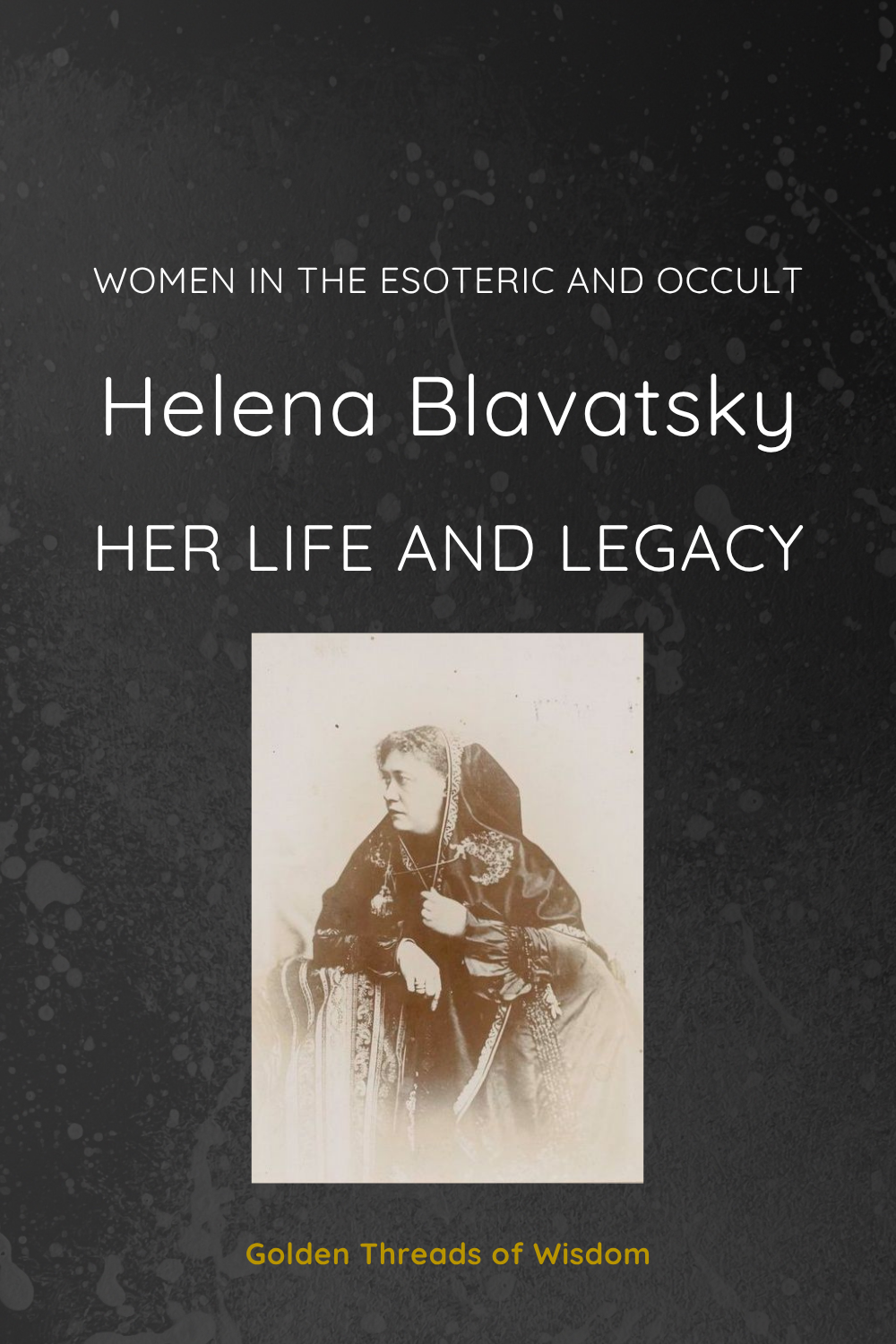
Helena Blavatsky: Her Life and Legacy | Women in the Esoteric and Occult
On the 17th of November 1875 in New York, a society was founded that would help spark a movement that spread across the Western world and beyond. It would go on to influence many magical and mystical societies and movements in the early 20th century.
Unlike many societies at the time, this one wasn’t entirely male-dominated, as one of the cofounders, and probably its most famous one, was a woman.
I’m talking, of course, about Helena Blavatsky and the Theosophical Society. And this is her story.
If you want early access to my posts, as well as additional content, join my Patreon.
The Life
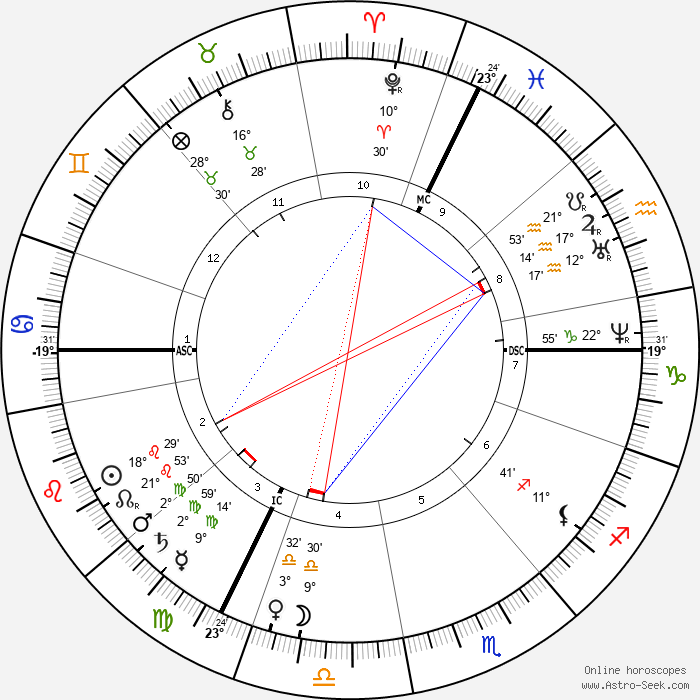
Helena Blavatsky, also known as HPB, was born on the 12th of August 1831 in Yekaterinoslav in the former Russian Empire, which is now Dnipro in Ukraine.
In short, Blavatsky was a mystic, spiritualist, clairvoyant, and psychic. From a young age, she was fascinated by the hermetic tradition and traveled the world in search of hidden wisdom.
Creating a reliable biography of Blavatsky’s life has apparently been difficult. One reason is that later in life, she gave contradictory–and sometimes false–versions of her own past. Another reason is that very little of what she wrote before 1873 survived, meaning that biographers have had to rely on her later writings, which some consider unreliable.
So honestly, if you’re deeply interested in Helena Blavatsky, I’d recommend doing your own research. What I want to do here is give a broad overview of her life and the context of the world she lived in, while facocusing mainly on her work and legacy.
With that said, Helena Blavatsky was born into an aristocratic family. Because her father was an aristocrat and served in the Russian Royal Horse Artillery, the family frequently traveled around the Russian Empire. That may have influenced Blavatsky’s nomadic lifestyle later in life.
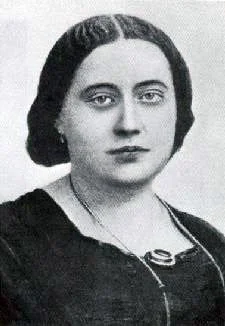
Helena Blavatsky, c. 1850
She had Russian and German ancestry, along with some French heritage a few generations back. It’s also said that she spoke several languages, including Russian, Georgian, English, French, Italian, Arabic, and Sanskrit.
Like her mother and grandmother, she was largely self-educated–likely because women at the time weren’t allowed access to most formal educational institutions.
In her teens, she reportedly became deeply interested in Western esotericism. This period of her life is where biographers are conflicted about her story, largely because there are few written records and very little evidence to verify her claims. One biographer even mentioned that myth and reality merged to create the story of this part of her life.
According to Blavatsky herself, she began traveling the world in 1849. She, in particular, traveled around Europe, Asia, and even through some parts of North America. During these travels, she claimed to have encountered the “Masters of Ancient Wisdom”, also known as the “Ascended Masters”.
In Theosophy, these beings were believed to be spiritually enlightened individuals who had once been ordinary humans in previous incarnations. Blavatsky claimed these Masters instructed her to travel to Tibet, where she would be trained in the synthesis of religion, philosophy, and science–ideas that would later become foundational to Theosophy.
One reason her travels have been questioned is her claim that she entered Tibet, which was closed to Europeans during the 1800s. At one point, she said she failed to enter, then later claimed she succeeded during another attempt in 1856.
Whether it was true or not that she’d been able to enter Tibet is something I will leave unsaid. However, Tibet became important in her mythology and teachings. She claimed it was there that she learned an ancient hidden language called Senzar, and that two Ascended Masters she claimed to be in contact with–Koot Hoomi and Morya–helped her develop and control her psychic abilities. I will come back to the Ascended Masters later.
After her alleged travels in Tibet, she returned to Europe and eventually reunited with her family in Pskov, in western Russia, in 1858.
Around this time, she began displaying stronger paranormal abilities, which she gained full control of after a riding accident fractured her spine and left her in a coma for several months.
After recovering, she continued traveling throughout Europe. It was during this time that she might have studied the Kabbalah with a rabbi as well.
Whether all these travels were real, completely fictitious, or somewhere in between is still debated today.
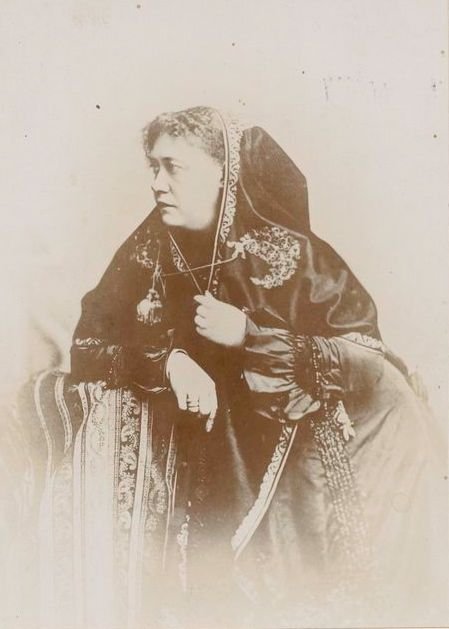
Blavatsky in 1875
Again, whether it’s true or not isn’t something that I will speculate on here. Personally, I’m less interested in whether every event literally happened or not, and more interested in the influence these places, cultures, and traditions she may or may not have been exposed to had on her worldview and work.
Even if some details were exaggerated, the cultures and spiritual traditions she referenced clearly shaped her ideas.
And while parts of her earlier travels are debated, we do know she later traveled to India and founded a Theosophical headquarters there, because there are photographs of her in India from the 1880s. This was after the founding of the Theosophical Society in New York, and after the publication of her, I would say, most famous book, Isis Unveiled, in 1877.
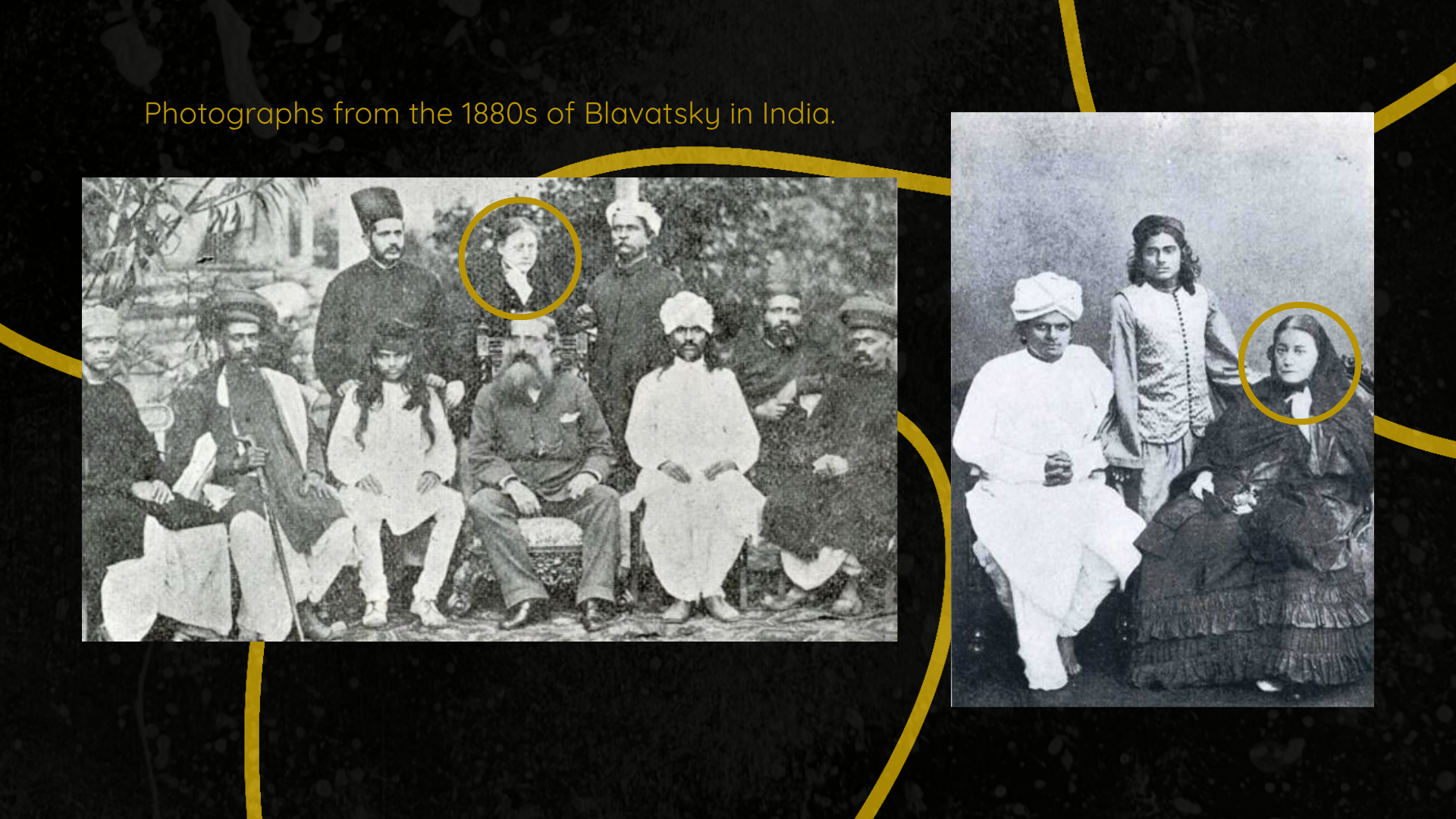
Left: Blavatsky standing behind Olcott (middle seated) and Damodar Mavalankar (seated to his left), Bombay, 1881. Right: Blavatsky and Hindu Theosophists in India, c. 1884
And with that, let’s move into her work and legacy.
The Work and Legacy
I’ll be honest and say that I haven’t personally read any of Blavatsky’s work, simply because it doesn’t fully align with my current interests. Maybe I’ll dive into it more deeply in the future, if and when I feel the need.
The reason I wanted to highlight her in this series, though, is that the Theosophical Society–which she co-created–sets the stage for many of the other women I’ll talk about in this series. So while I can’t give a personal analysis of Blavatsky’s writing, I have researched the ideas, influence, and legacy surrounding her work, which is what I’ll dive into now.
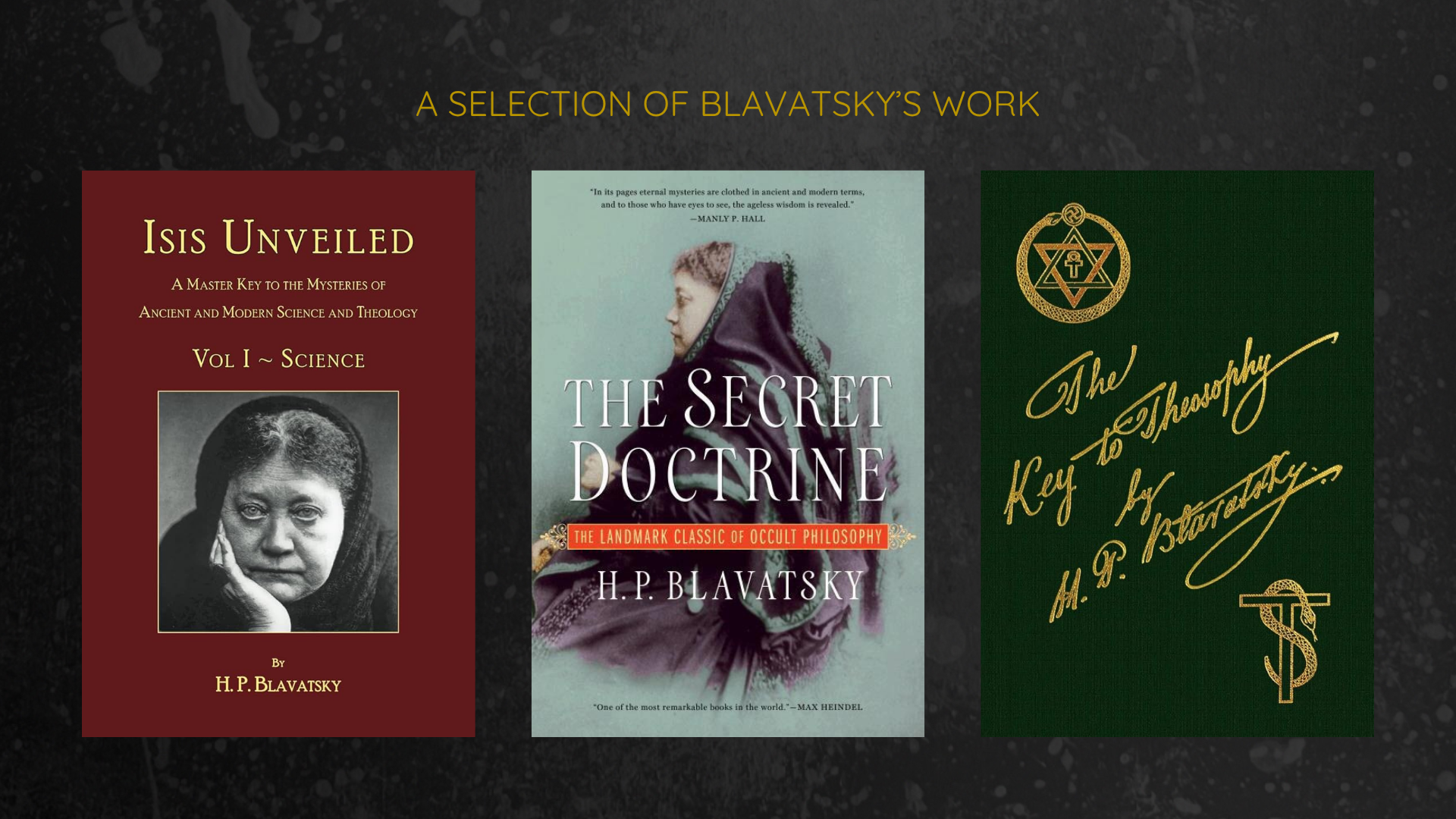
A selection of Blavatsky’s work: Isis Unveiled (originally published in 1877), The Secret Doctrine (originally published in 1888), and The Key to Theosophy (originally published in 1889)
As I mentioned earlier, the Theosophical Society was founded in New York in 1875 and would go on to heavily influence many magical and mystical movements in the early 20th century.
On the commemorative plaque that can be found in Adyar in India, the society lists its three points as the main objects:
To form a nucleus of the Universal Brotherhood of Humanity, without distinction of race, creed, sex, caste or colour.
To encourage the study of Comparative Religion, Philosophy and Science.
To investigate unexplained laws of nature and the powers latent in man.
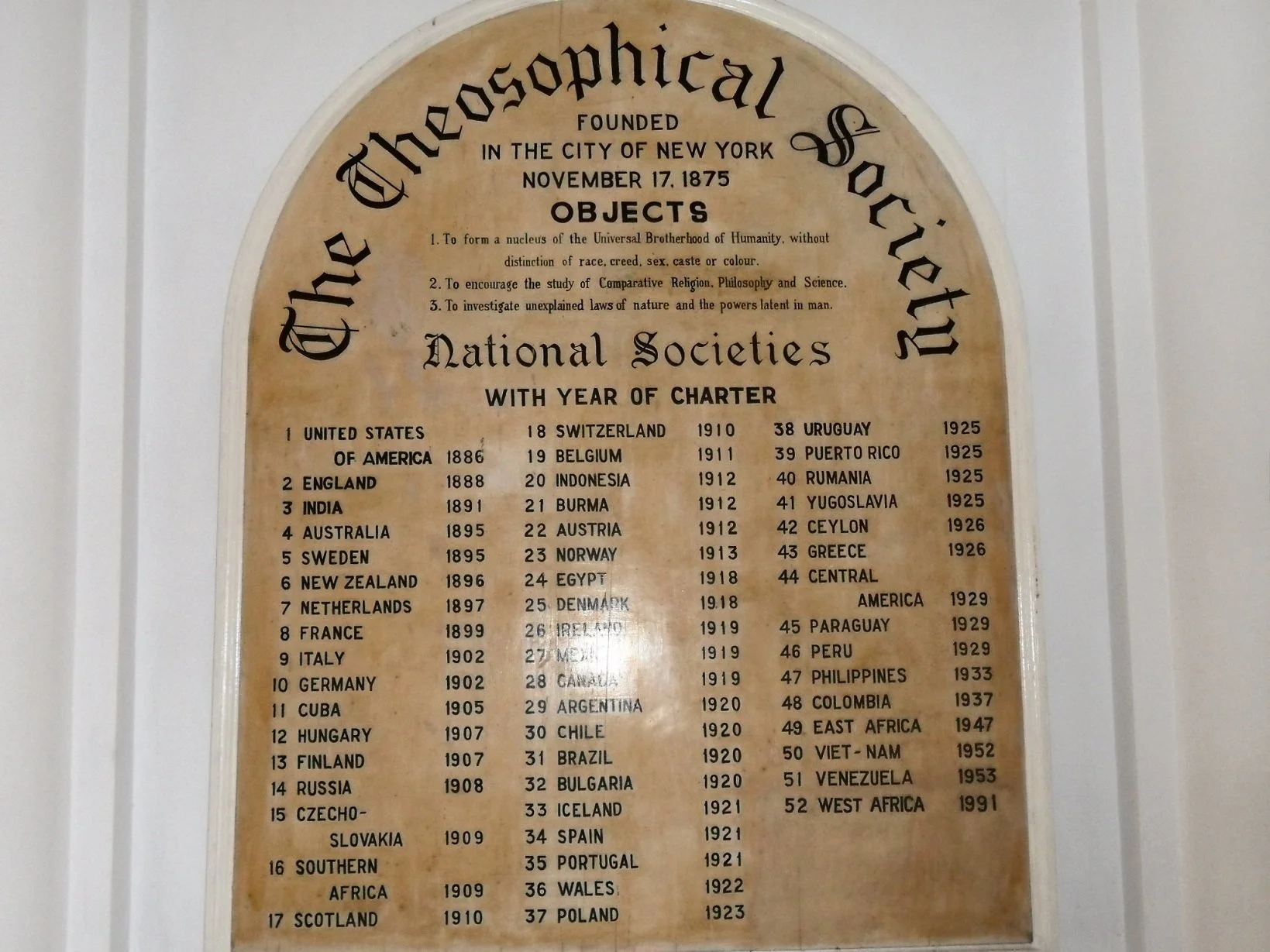
Commemorative plaque of Theosophical Society, Adyar, India
These ideas shaped Blavatsky’s work and the movement that grew around it, and I will come back to these throughout this whole part on her work and legacy.
One of the Theosophical Society’s core principles that builds upon the second object, however, was the blending of Eastern and Western spiritual, occult, and esoteric thinking and traditions. You can even see this reflected in the society’s seal, which combines symbols like:
The Aum: a sacred syllable in Sanskrit
The Swastika: a benevolent symbol representing good fortune and spirituality or continuing creation in major Asian religions before it was appropriated by the Nazi movement
The Star of David: the most universally recognized symbol of Judaism
The Ankh: an ancient Egyptian hieroglyph that represents eternal life
The Ouroboros: the serpent eating its own tail, which represents the eternal cycle and wholeness

The Theosophical Society's seal
Some versions also include the tagline “There Is No Religion Higher Than Truth” along the bottom of the seal.
The word “Theosophy” itself means “God’s wisdom” or “divine wisdom” as the Greek words “theos” means “god” and “sophia” means “wisdom”.
Theosophy is largely based on a mix of older European philosophies, such as Neoplatonism, as well as Asian religions, such as Hinduism, Buddhism, and Zoroastrianism. While Blavatsky insisted Theosophy wasn’t a religion, many scholars later categorized it as both a new religious movement and as a form of occultism within Western esotericism.
Followers of Theosophy generally saw it less as a religion and more as a system that sought deeper truths shared across religion, philosophy, and science. One of its most fundamental ideas was that all of us come from the same spiritual and physical origins because we’re essentially from the same infinite, eternal essence underlying all existence.
According to Blavatsky, Theosophy itself came from an ancient brotherhood of spiritual adepts known as the Ascended Masters, whom I mentioned earlier. These Masters were believed to preserve humanity’s ancient spiritual wisdom and were attempting to revive the knowledge of an ancient religion that was once found around the world. This ancient religion was believed to, at some point, make a comeback to replace the currently existing world religions.
While some of the early Theosophists believed biblical figures, such as Abraham, Moses, Solomon, and Jesus, as well as Asian religious figures, such as Buddha, Confucius, and Laozi, were among the Masters, Blavatsky herself was said to most often be in contact with Koot Hoomi and Morya.
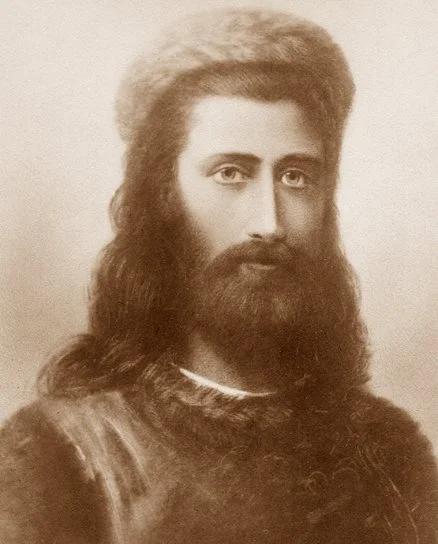
Portrait of Master Koot Hoomi by Hermann Schmiechen
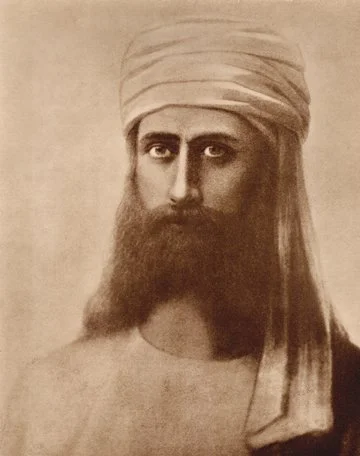
Portrait of Master Morya by Hermann Schmiechen
Isis Unveiled
According to her, these Masters guided much of her writing, including her first major work, Isis Unveiled, from 1877, just two years after the founding of the Theosophical Society. As I mentioned before, the book became quite popular and is still considered one of the foundational texts of the Theosophical movement.

Isis Unveiled: A Master-Key to the Mysteries of Ancient and Modern Science and Theology, published in 1877
In short, Isis Unveiled is divided into two volumes. The first volume, called Science, discusses occult science and explores unknown forces of nature like psychic phenomena, which Blavatsky claimed to have experienced herself. The second volume, called Theology, compares Christianity with Eastern religions like Buddhism, Hinduism, and Zoroastrianism.
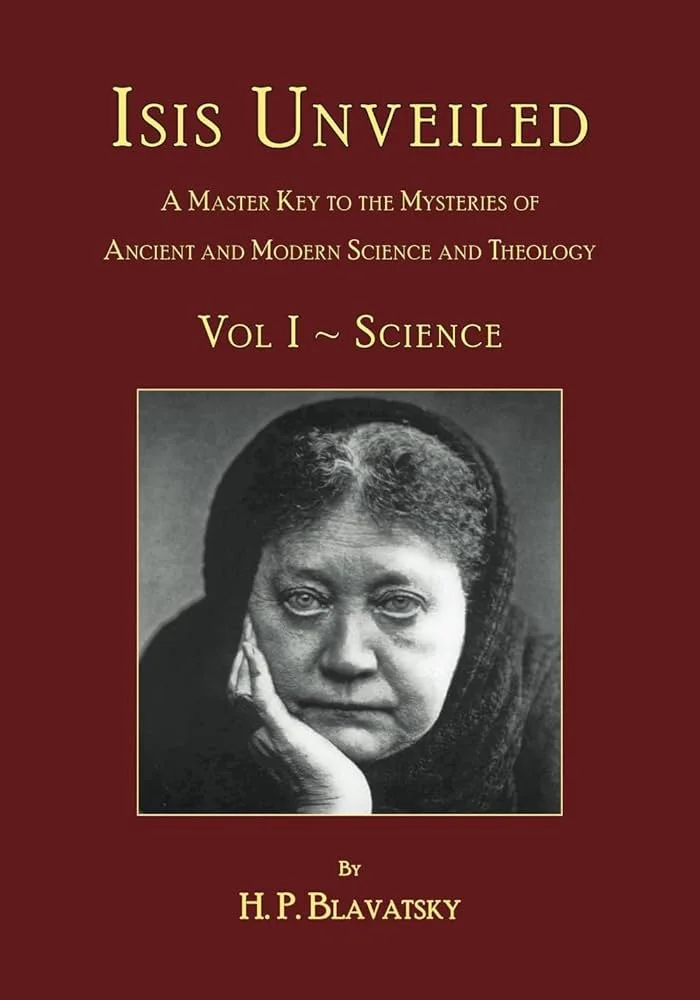
Isis Unveiled Vol 1 by HP Blavatsky (originally published in 1877)
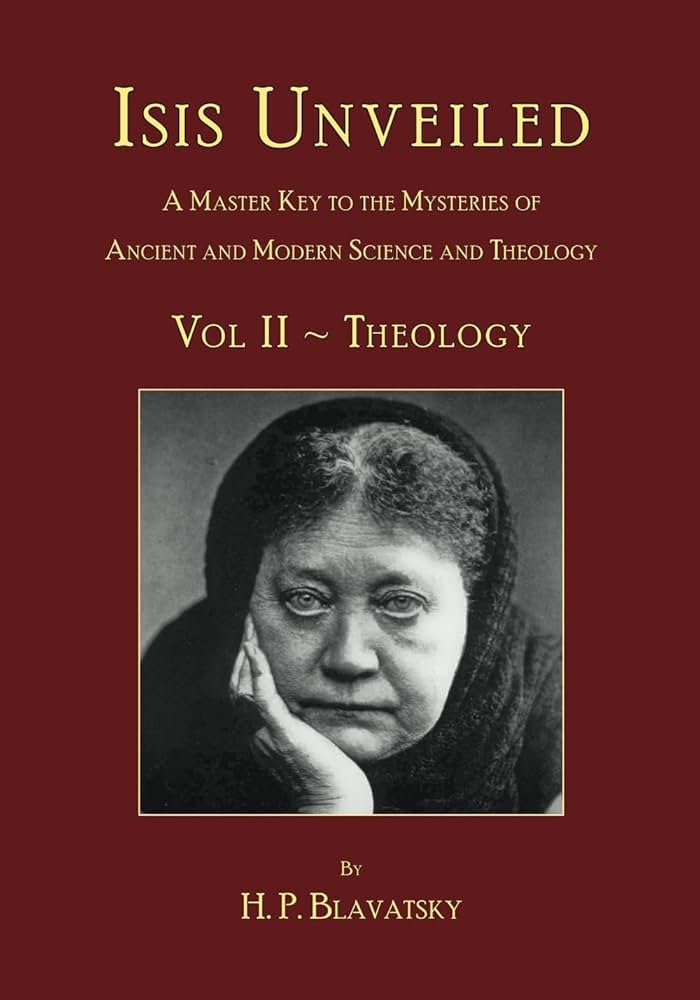
Isis Unveiled Vol 2 by HP Blavatsky (originally published in 1877)
There are, as I’ve understood it, two major themes from Isis Unveiled that shaped the entire Theosophical movement:
Blavatsky attempted to bridge together science, philosophy, and theology
She compared some Eastern and Western religions to argue that the world’s religions all descend from a shared ancient source–a lost universal wisdom tradition that threads through them all
According to this idea, all world religions have their importance, deep wisdom, and each contains fragments of truth, but the ancient universal religion they are rooted in includes a higher and bigger truth that not one single world religion of today holds by itself. None of them holds the complete picture. This universal ancient religion that humanity has lost over time, to be replaced with the current world religions, demonstrated what Blavatsky argued was a unity of religion and science that we have lost over time.
Personally, I find that idea really interesting because, as I’ve researched astrology, for example, it’s been interesting to uncover how astrology and astronomy were once deeply connected as the same field in ancient Mesopotamian times. Over time, much of that knowledge was lost, buried, or forgotten–only to, not until recent decades, be rediscovered and translated into modern languages to make them accessible to more people. These books and other sources on astrology include all this knowledge that we lost over time, but that we have regained again. And since that is true for astrology, I’m sure it can be true for religion as well.
While Isis Unveiled has been described as a milestone in Western Esotericism by some scholars, it’s not completely without controversy, considering Blavatsky was a Western woman writing about Eastern religions and traditions. She was also repeatedly accused of plagiarizing preexisting esoteric texts and ideas, which I will come back to later.
The Secret Doctrine
Another core part of the Theosophical belief system was the cosmology that Blavatsky wrote about in another of her influential works called The Secret Doctrine, published in 1888.
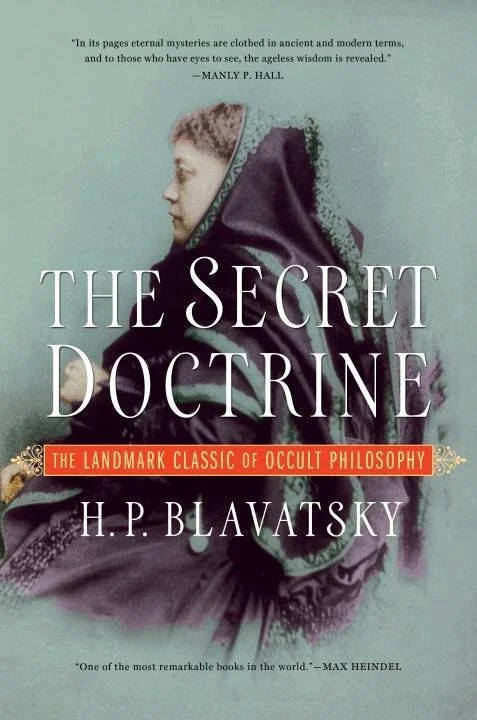
The Secret Doctrine by HP Blavatsky (originally published in 1888)
In short, like Isis Unveiled, The Secret Doctrine builds upon the themes Blavatsky wrote about in Isis Unveiled, as it bridges together science with philosophy and theology to create a cosmological framework.
The Secret Doctrine is also divided into two volumes. The first volume, called Cosmogenesis, includes Blavatsky’s interpretation of the origin and evolution of the universe. The second volume, called Anthropogenesis, describes the origin of humanity through what she called “Root Races”, which date back millions of years. Basically, the two volumes detail her ideas about the creation of our universe and all life here in our little corner of it.
And this is one of the areas where her work becomes especially controversial, as, just like with Isis Unveiled, The Secret Doctrine isn’t unproblematic either.
Controversy
Some scholars and biographers have pointed out that her writings were occasionally racist and antisemitic, particularly surrounding the idea of Root Races. Some even argue that aspects of these ideas later influenced Ariosophy and, indirectly, the aryan ideology of the Nazi movement.
Others have asserted that Blavatsky herself would likely have rejected those ideas regarding race if she had been alive to witness the development and rise of Ariosophy. Of course, we can’t know this for sure, as she died in 1891, the year after Ariosophy had just started in Austria. Either way, it’s important to acknowledge.
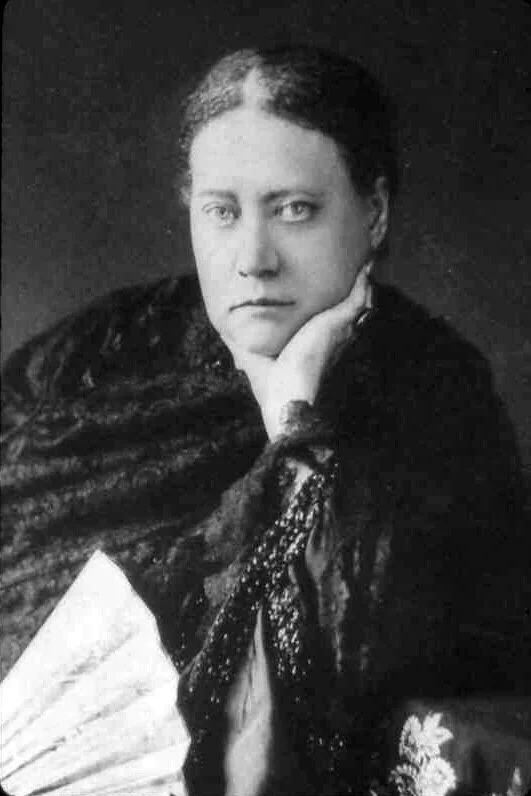
Blavatsky, c. 1877
In addition, The Secret Doctrine was also, like Isis Unveiled, accused of plagiarism. These kinds of accusations and criticism started already during her lifetime and have continued after her death. I won’t tell you what to believe about this. However, apparently, there are modern copies of, for example, Isis Unveiled with annotations that show the potential sources Blavatsky drew from.
As I mentioned before, I haven’t read her work, so I can’t really share an opinion on this. Maybe she did plagiarize older texts; maybe she didn’t. I’m not here to say that she did or didn’t or to persuade you to think a certain way. I suggest you do your own research and form your own opinion about that.
However, what I do think is important to mention regarding these accusations, though, is the broader social context of the time when she wrote, as well as who her critics were, because I believe that context matters.
First of all, during the 1800s, women in the Western world (and perhaps beyond) were often seen as incapable of producing something of their own, something unique, original, or different. The dominant belief was that women could only reproduce or imitate what had already been done and existed. Women were, basically, only able to copy others. They were only able to copy that which already existed.
Whether Blavatsky internalized those ideas herself, whether she believed that copying from older texts was all she was able to do as a woman, or whether sexism played a role in the criticism and accusations aimed at her is something I can only speculate on. But it’s still worth thinking about.
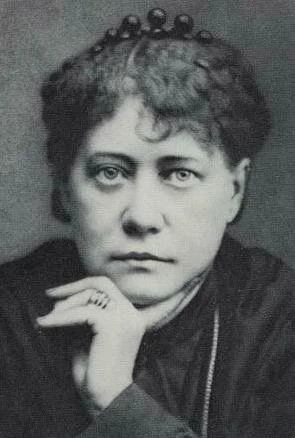
HP Blavatsky in 1877
Secondly, it’s also interesting that many of the major figures who accused her of fraud or plagiarism were men. William Emmette Coleman was a man, Arthur Lillie was a man, Elliott Coues was a man, René Guénon was a man, Carl Jung (yes, the Carl Jung) was a man, Agehananda Bharati, Max Müller, Mircea Eliade, John Nevil Maskelyne, Robert Todd Carroll, James Randi, and Peter Washington were all men. And these are just some of the ones I could easily find.
Now, I am not suggesting that these men were misogynistic assholes or that their critique is wrong or invalid, but it’s still interesting that so many who accused her of being a fraud were men. And historically, male voices were far more likely to be taken seriously and widely published than women’s voices were, which might be why I haven’t been able to find any substantial critique from women.
I mean, there is Mabel Collins, who may or may not have been expelled from the Theosophical Society and may or may not have criticized Blavatsky as a reason for that. There’s also the so-called Coulomb Affair, which included Emma Coulomb, who alleged that Blavatsky was a fraud, but their alleged evidence, which included letters, was destroyed, allegedly by one of Blavatsky’s enemies (Elliott Coues, who was a man, by the way).
At the same time, when you compare Blavatsky’s critique to someone like Henry Steel Olcott–one of the male cofounders of the Theosophical Society–the contrast becomes interesting.
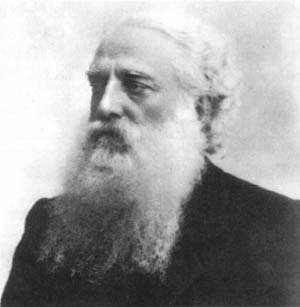
Photograph of H.S. Olcott, one of the founders of Theosophy
Olcott is often remembered and described as someone who wanted to preserve sacred texts from the Buddhist, Hindu, and Zoroastrian religions to, basically, save the Asian continent and its religions, as well as avoid the Westernized interpretations of these sacred texts found in America, so that he could properly educate Westerners on these religions.
From what I’ve read about him, it’s almost as if he himself believed that he was this hero who would save the Asian continent from spiritual death and spread their doctrines to the West, and that has become a part of his legacy that is celebrated today. Of course, with today’s eyes, you can see the white supremacist and colonial tendencies here, just like in Blavatsky’s work. So, I guess that is some of the critique that’s aimed at Olcott and his work. But there is nothing like the accusations of fraud that damaged Blavatsky’s reputation and that she had to deal with during her lifetime that Olcott had to deal with during his (at least nothing I could find).
The Legacy
While Blavatsky’s story about her own life can be questioned, and whether her work is the result of plagiarism or not, her influence is still undeniable. Her role as cofounder of the Theosophical Society isn’t disputed, and the movement spread fast and wide.
By 1885–just ten years after its founding–Theosophy had spread across Europe and beyond, becoming quite popular in South and Southeast Asia, where there were 106 lodges in India, Burma (now called Myanmar), and Ceylon (now called Sri Lanka). This was after both Blavatsky and Olcott relocated to India in the early 1880s, where they established a headquarters at Adyar. For the late 1800s, that level of international growth is honestly pretty incredible.
Perhaps the rapid spread was based on a comfort or wisdom that the followers found in the Theosophical teachings. Maybe the interest was driven by a curiosity for esoteric thoughts from a different perspective. Maybe it was Blavatsky’s charisma. Maybe it was all of those things or something completely different.
Whatever the reason, Helena Blavatsky remains an incredibly fascinating figure, and I think the differing opinions about her are well-suited for such a complex, influential, and mysterious woman.
And regardless of how people feel about her personally, her legacy within Western esotericism and occultism is impossible to ignore. The movement she helped build spread across the world and has been established on all continents except Antarctica (which is a shame for the penguins, lol). The movement she cofounded influenced countless mystical, occult, and spiritual movements that came after it. Her ideas helped shape parts of modern Western esotericism, New Age spirituality, and occult philosophy, and it still continues to influence spiritual and esoteric thought even today. That legacy makes her an absolute legend within Western esotericism and occultism.
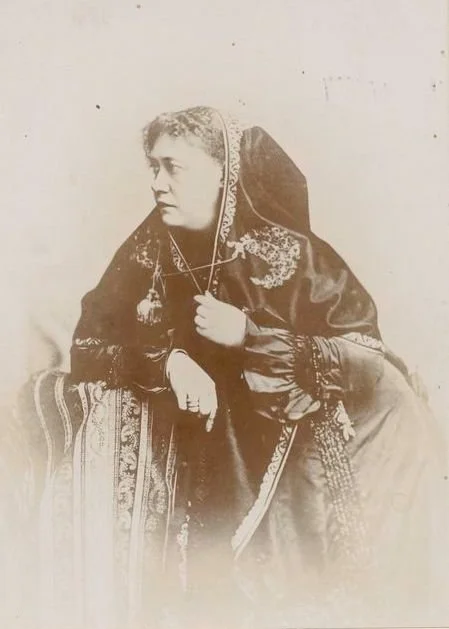
Blavatsky in 1875
And honestly, I think the conflicting opinions surrounding her only make her more interesting. Part of what makes her so fascinating is that she refuses to fit neatly into a single category.
So with all of that said, what do you think about Helena Blavatsky, her work, and her legacy? Share your thoughts in the comments below.
If you want early access to my posts, as well as additional content, join my Patreon.
Sources
“Ascended master”, Wikipedia, https://en.wikipedia.org/wiki/Ascended_master (Accessed 2026-05-18)
“Coulomb Affair”, Wikipedia, https://en.wikipedia.org/wiki/Coulomb_Affair (Accessed 2026-05-18)
“Helena Blavatsky”, Wikipedia, https://en.wikipedia.org/wiki/Helena_Blavatsky (Accessed 2026-05-18)
“Henry Steel Olcott”, Wikipedia, https://en.wikipedia.org/wiki/Henry_Steel_Olcott (Accessed 2026-05-18)
“Isis Unveiled”, Wikipedia, https://en.wikipedia.org/wiki/Isis_Unveiled (Accessed 2026-05-18)
“Mabel Collins”, Wikipedia, https://en.wikipedia.org/wiki/Mabel_Collins (Accessed 2026-05-18)
“Theosophical Society”, Wikipedia, https://en.wikipedia.org/wiki/Theosophical_Society (Accessed 2026-05-18)
“William Quan Judge”, Wikipedia, https://en.wikipedia.org/wiki/William_Quan_Judge (Accessed 2026-05-18)
Dell, Christopher. The Occult, Witchcraft & Magic: An Illustrated History. London: Thames & Hudson, 2016.
Images
Blavatsky and Hindu Theosophists in India, c. 1884. By unknown - http://fundacionblavatsky.org/textos/portal/alumnos/Subba%20Row,%20T.%20Garu%20.html, Public Domain, https://commons.wikimedia.org/w/index.php?curid=16259749 (Accessed 2026-05-18)
Blavatsky and Olcott in 1888. Public Domain, https://commons.wikimedia.org/w/index.php?curid=708016 (Accessed 2026-05-18)
Blavatsky in 1875. By Historical and Public Figures Collection - New York Public Library Archives, Public Domain, https://commons.wikimedia.org/w/index.php?curid=16259756 (Accessed 2026-05-18)
Blavatsky, c. 1877. By unknown - http://www.Theosophycanada.com/pics/slide25.jpg, Public Domain, https://commons.wikimedia.org/w/index.php?curid=2360327 (Accessed 2026-05-18)
Blavatsky standing behind Olcott (middle seated) and Damodar Mavalankar (seated to his left), Bombay, 1881. By unknown - http://www.blavatskyarchives.com/hpbphotos10.htm, Public Domain, https://commons.wikimedia.org/w/index.php?curid=2176991 (Accessed 2026-05-18)
Commemorative plaque of Theosophical Society, Adyar, India. By Milei.vencel, Hungary - Own work, CC BY-SA 3.0, https://commons.wikimedia.org/w/index.php?curid=22215522 (Accessed 2026-05-18)
Helena Blavatsky, c. 1850. By unknown - http://www.blavatskyarchives.com/hpbphotos4.htm, Public Domain, https://commons.wikimedia.org/w/index.php?curid=2176952 (Accessed 2026-05-18)
HP Blavatsky. By Unsure - http://www.blavatskyarchives.com/hpbphotos6.htm, Public Domain, https://commons.wikimedia.org/w/index.php?curid=66334 (Accessed 2026-05-18)
Isis Unveiled: A Master-Key to the Mysteries of Ancient and Modern Science and Theology, published in 1877. By Helena Petrovna Blavatsky - https://archive.org/services/img/b24886154_0002, Public Domain, https://commons.wikimedia.org/w/index.php?curid=72547138 (Accessed 2026-05-18)
Isis Unveiled Vol 1 by HP Blavatsky, book cover
Isis Unveiled Vol 2 by HP Blavatsky, book cover
Photograph of H.S. Olcott, one of the founders of Theosophy. Public Domain, https://commons.wikimedia.org/w/index.php?curid=2273611 (Accessed 2026-05-18)
Portrait of Master Koot Hoomi by Hermann Schmiechen. By Hermann Schmiechen - https://blavatskyarchives.com/koothoomiportrait5.htm, Public Domain, https://commons.wikimedia.org/w/index.php?curid=14998956 (Accessed 2026-05-18)
Portrait of Master Morya by Hermann Schmiechen. By Hermann Schmiechen - https://blavatskyarchives.com/moryaportrait5.htm, Public Domain, https://commons.wikimedia.org/w/index.php?curid=10954743 (Accessed 2026-05-18)
The Key to Theosophy by HP Blavatsky, book cover
The Secret Doctrine by HP Blavatsky, book cover
The Society's seal. By Frater5, Public Domain, https://commons.wikimedia.org/w/index.php?curid=2214981 (Accessed 2026-05-18)
William Quan Judge. Public Domain, https://commons.wikimedia.org/w/index.php?curid=693407 (Accessed 2026-05-18)