Pluto: From a Mythological and Symbolic Perspective
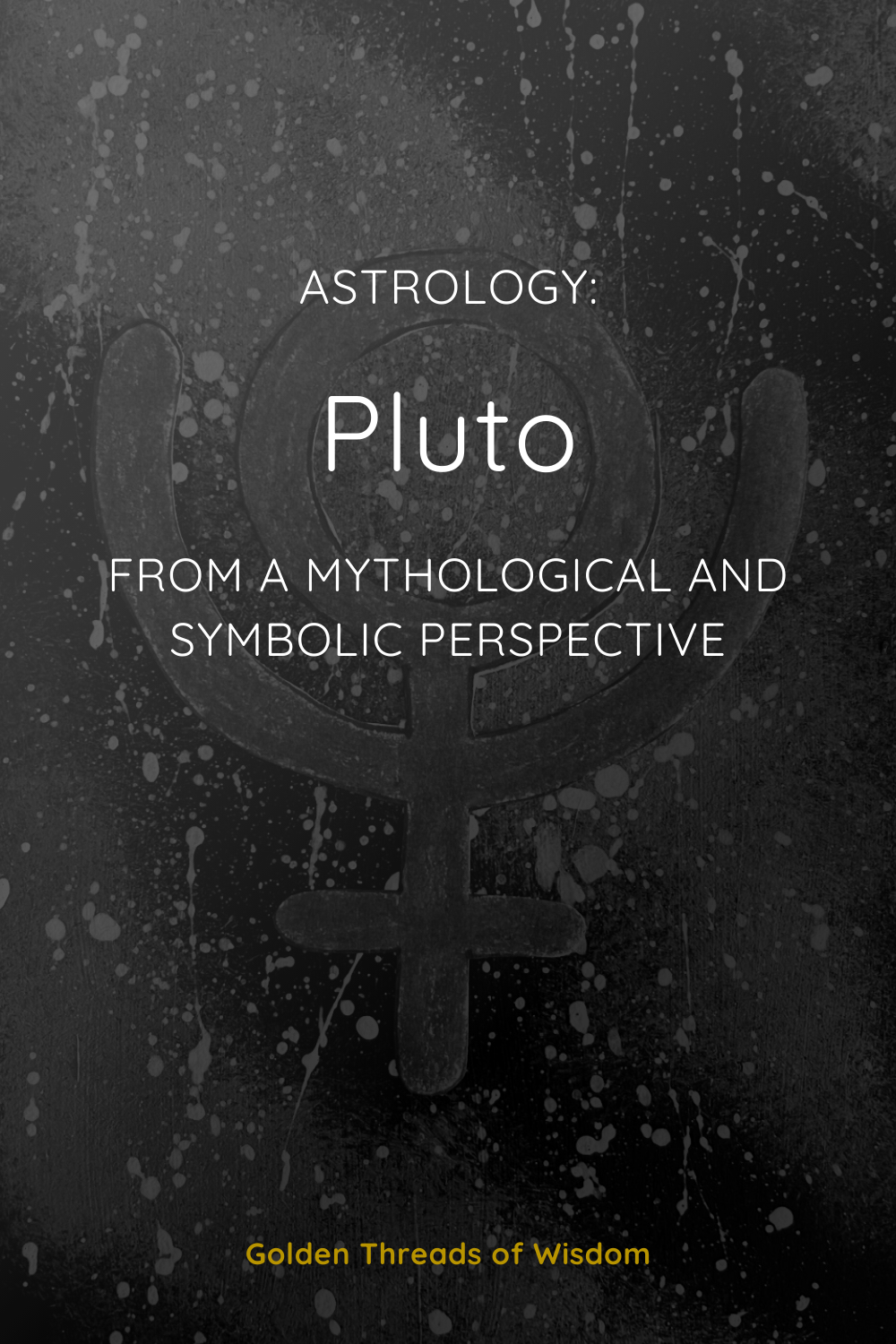
As I’ve been on my astrology journey, one of the ways I’ve connected to the planets has been through their mythological and archetypal correspondences, accompanied by the symbolism astrologers use to describe what the planets signify.
With that in mind, this series of posts about the different parts of astrology, where I’ll cover the luminaries and each of the planets in our solar system, I’ll write about their mythology, archetypes, and some general symbolism, including my own observations.
In this post, I will focus on Pluto.
[I will add to this post when I broaden my knowledge of myths, deepen my knowledge of the planets, and make new observations concerning them.]
If you want early access to my posts, as well as additional content, join my Patreon.
The Mythology of Pluto
Like Uranus and Neptune, Pluto is one of the more recently discovered planets (yes, I will call it a planet) in our solar system and may, therefore, not always have a clear-cut association with the deity it’s named after (more on this below).
Pluto is associated with the underworld. In Greek mythology, there were two kinds of underworlds. The first was Hades, ruled over by the god of the same name (conflated with other figures as Pluto in Roman mythology, and the one who gave this planet its name). Hades was where the dead dwelt. Tartarus, on the other hand, was the caves beneath the earth, far beneath Hades, a pit of suffering and a place for punishment.
In Norse mythology, the goddess of the underworld was Hel.
In Mesopotamian mythology, the underworld was ruled by Ereshkigal.
In the Yoruba tradition in West Africa, Pluto is associated with the wild woodsman called Ogun. He is a maker and a builder who can create civilizations, but if untamed, he will eventually destroy them as well.
Now, in Cosmos and Psyche, Richard Tarnas comments on the not always so clear-cut link between the more recently discovered outer planets’ archetypes and the deities they’re named after:
“Compared with the planets known to the ancients, with their Greco-Roman mythological associations and corresponding astrological meanings, the names and meanings of the three planets discovered by telescope in the modern era present a very different situation. Uranus, Neptune, and Pluto were named by modern astronomers without any archetypal correspondences in mind. They therefore inherited no archetypal meanings sanctioned by ancient tradition, meanings that were in turn affirmed, refined, and elaborated by continuing observations over many centuries. [...] While correlations involving the ancient planets out through Saturn consistently suggest a definite coherence between the planets’ inherited mythological names and the observed synchronistic phenomena, correlations involving the outer three planets point to archetypal principles that in crucial respects differ from or radically transcend their astronomical names.” (Tarnas, 2006, ch. 3).
Below, I’ll first write a bit about the deity the planet is named after, before exploring the archetypes that fit the planet’s qualities better.
Hades
In Greek mythology, Hades “was the god of the Underworld, Lord of the Dead, the god of death, and even death personified” (Giesecke 2020). He was the child of Kronos and Rhea and the first swallowed whole by his father. Later, after Rhea tricked Kronos and gave birth to Zeus in secret, Hades and his other brothers and sisters, who were swallowed whole, were rescued by Zeus and their mother.
The siblings thanked Zeus, created a new world order together, and became the Olympian gods. When the three brothers (Zeus, Hades, and Poseidon) were to establish their individual dominions, they drew lots, and Hades was awarded the underworld.
The most well-known myth surrounding Hades was the abduction of his bride, Persephone. He took her by force as she was picking flowers in a meadow. Demeter, Persephone’s mother and the goddess of the seasons and harvest, was stricken with so much grief for losing her daughter that the world was plunged into a deadly famine as she searched for Persephone. Eventually, Hades allowed Persephone to return to her mother for a limited time.
The only reason Hades agreed to let Persephone go, at least for a period of the year, was because his brother Zeus had threatened him, saying that Hermes would no longer bring more spirits of the dead down to him in the underworld. While that angered Hades, who wanted to fill his own realm with the spirits of the dead, he tricked Persephone into eating the pomegranate seeds. Since she ate six of them, she had to return to the underworld for six months every year. That’s how the six months of blooming spring and summer and the six months of withering autumn and fall came to be our seasons and signified with birth and life versus death and decay.
While Hades is associated with the underworld, he also became the symbol of riches and opulence. The precious metals, gemstones, and jewels were riches that were mined deep underground, and therefore became associated with Hades. “He was also called Pluto, the God of Wealth, of the precious metals hidden in the earth” (Hamilton 1942).
While the mythology of the other gods and goddesses that the planets in our solar system are named after usually go very well hand-in-hand, Pluto is a fairly newly discovered planet, as mentioned above. While Pluto is associated with the underworld and the riches in the subterranean levels of the Earth that Hades is also associated with, it can still be beneficial to look at other mythological beings and archetypes to understand the archetype of Pluto better. For example, the deity Dionysus.
Dionysus
While Pluto is traditionally associated with Hades and the underworld, it also shares archetypal aspects with Dionysus (also called Bacchus). Dionysus was the god of wine. Together with Demeter, he provided humankind with basic sustenance. This is no doubt part of why he was so popular.
Dionysus was also “the god of blurred distinctions, an effeminate shape-shifter, doubtless to some degree an effect of his sacred wine. As such, he was the opposite of his half brother, Apollo, the god of order” (Giesecke 2020).
Dionysus was the son of Zeus and a Theban princess called Semele. “He was the only god whose parents were not both divine” (Hamilton 1942). Considering Zeus is involved, Dionysus’s origin story isn’t without its problems.
Hera, pissed about her husband’s wandering eye, made Semele doubt she was sleeping with a god, which resulted in Semele asking Zeus for a favor, which he had to grant since he’d promised to do anything she asked of him:
“she asked him to appear to her in his full divinity, and as a result, she was incinerated. Zeus rescued the unborn Dionysus and placed him in his thigh. After nine months, Dionysus emerged and was taken to the Nysaean Nymphs to raise. According to an alternate myth, Dionysus was raised by his mother’s sister Ino” (Giesecke 2020).
In his youth, Dionysus discovered that he could make wine from grapes, which became one of the things that are associated with him, together with the intoxication and inebriation that can result from drinking wine. It came about when his lover Ampelos died in a race between himself and his lover, and Dionysus transformed his body into a vine, his blood turning into grapes. Dionysus then traveled far and wide to share this skill of wine-making with other places.
And so, “the grapevine and ivy, a plant emblematic of eternal life, were especially sacred to him. His typical companions were Satyrs and Silens, lusty hybrid creatures, as well as Maenads, his female followers” (Giesecke 2020). The Maenads “were women frenzied with wine. They rushed through woods and over mountains uttering sharp cries, waving pine-cone-tipped wands, swept away in a fierce ecstasy. Nothing could stop them. They would tear to pieces the wild creatures they met and devour the bloody shreds of flesh” (Hamilton 1942). These followers of Dionysus “went to the wilderness to worship, to the wildest mountains, the deepest forests” (Hamilton 1942) where Dionysus gave them food and drink. “There was much that was lovely, good, and freeing in this worship under the open sky and the ecstasy of joy it brought in the wild beauty of the world. And yet always present, too, was the horrible bloody feast” (Hamilton 1942).
Dionysus could give any of these opposites to his followers: freedom or ecstasy, joy or savagery. “Throughout the story of his life he is sometimes man’s blessing, sometimes his ruin” (Hamilton 1942), just like the wine he’s associated with.
Of all the terrible deeds that were associated with Dionysus, the worst was done in Thebes, where he arrived to establish his worship. He was accompanied by his Maenads, who were exuding joy. But Dionysus “met resistance from his cousin, Pentheus, the young regent, who refused to acknowledge his divinity” (Giesecke 2020). Pentheus had no idea Dionysus was his cousin and thought the wild dancing and loud singing of these strangers was distasteful. He ordered Dionysus and his followers to be seized and imprisoned. Dionysus, who asked Pentheus to welcome this new worship, left Pentheus to his doom after refusing and cursing them out.
As Pentheus went to pursue Dionysus’s followers, Dionysus showed his most terrible side. “Pentheus was torn to pieces by his own mother and her sisters while they were in a Bacchic trance” (Giesecke 2020), mistaking Pentheus for a mountain lion. Only when he’d been torn apart did Dionysus restore the senses of his followers.
“The ideas about Dionysus in these various stories seem at first sight contradictory. In one he is the joy-god [...] In another he is the heartless god, savage, brutal [...] The truth is, however, that both ideas arose quite simply and reasonably from the fact of his being the god of wine. Wine is bad as well as good. It cheers and warms men’s hearts; it also makes them drunk. The Greeks were a people who saw facts very clearly. They could not shut their eyes to the ugly and degrading side of wine-drinking and see only the delightful side. [...] The reason that Dionysus was so different at one time from another was because of this double nature of wine and so of the god of wine. He was man’s benefactor and he was man’s destroyer” (Hamilton 1942).
Because Dionysus was associated with the vine, there’s a natural regeneration and life-death-rebirth cycle associated with him as well:
“He was the vine, which is always pruned as nothing else that bears fruits; every branch cut away, only the bare stock left; through the winter a dead thing to look at, an old gnarled stump seeming incapable of ever putting forth leaves again. Like Persephone Dionysus died with the coming of the cold. Unlike her, his death was terrible: he was torn to pieces, in some stories by the Titans, in others by Hera’s orders. He was always brought back to life; he died and rose again” (Hamilton 1942).
The Symbolism of Pluto
Fast Facts
Keywords: Elimination, eruptive change, crisis, survival, cycles of birth, death and rebirth, regeneration, transformation, metamorphosis, taboos and secrets, hidden things, power, dictatorship, control, obsession
Domicile: Scorpio (in modern astrology)
Detriment: Taurus (in modern astrology)
Anatomy: Elimination and reproductive systems, abnormal, gross, pituitary gland
Colors: Maroon, dark red, and brown
Metal: Plutonium and iron
Stones: Diamond, bloodstone, and agate
Discovered in 1929.
Pluto spends on average between fourteen and thirty years in each sign due to its elliptical orbit around the Sun.
Symbolism
Pluto is often connected to the death-rebirth cycles, transformation, and regeneration. In that way, it’s also connected to breaking down structures and creating new ones in their place.
Pluto is also connected to power, a desire to understand and influence the masses, as well as to the collective consciousness. Pluto also rules the subconscious, the more “underworldly” ideas and beliefs we might have difficulty accessing. Some of these can be shadow sides of our psyche.
Pluto is also associated with pleasure, sex, obsession, and things that are deemed taboo.
Pluto intensifies and empowers whatever it touches during transits and through aspects.
Richard Tarnas summarizes Pluto’s correspondences and archetype in the following way in Cosmos and Psyche:
“Pluto is associated with the principle of elemental power, depth, and intensity; with that which compels, empowers, and intensifies whatever it touches, sometimes to overwhelming and catastrophic extremes; with the primordial instincts, libidinal and aggressive, destructive and regenerative, volcanic and cathartic, eliminative, transformative, ever-evolving; with the biological processes of birth, sex, and death, the cycle of death and rebirth; with upheaval, breakdown, decay, and fertilization; violent purgatorial discharge of pent-up energies, purifying fire; situations of life-and-death extremes, power struggles, all that is titanic, potent, and massive. Pluto represents the underworld and underground in all senses: elemental, geological, instinctual, political, social, sexual, urban, criminal, mythological, demonic. It is the dark, mysterious, taboo, and often terrifying reality that lurks beneath the surface of things, beneath the ego, societal conventions, and the veneer of civilization, beneath the surface of the Earth, that is periodically unleashed with destructive and transformative force. Pluto impels, burns, consumes, transfigures, resurrects. In mythic and religious terms, it is associated with all myths of descent and transformation, and with all deities of destruction and regeneration, death and rebirth: Dionysus, Hades and Persephone, Pan, Medusa, Lilith, Inanna, Isis and Osiris, the volcano goddess Pele, Quetzalcoatl, the Sepent power, Kundalini, Shiva, Kali, Shakti.” (Tarnas, 2006, ch. 3).
As with Uranus and Neptune, there was also a range of historical and cultural phenomena that coincided with the discovery of Pluto that have become a part of its significance. As Tarnas writes:
“With respect to Pluto’s discovery, the synchronistic phenomena in the decades immediately surrounding 1930, and more generally in the twentieth century, include the splitting of the atom and the unleashing of nuclear power; the titanic technological empowerment of modern industrial civilization and military force; the rise of fascism and other mass movements; the widespread cultural influence of evolutionary theory and psychoanalysis with their focus on the biological instincts; increased sexual and erotic expression in social mores and the arts; intensified activity and public awareness of the criminal underworld; and a tangible intensification of instinctually driven mass violence and catastrophic historical developments, evident in the world wars, the holocaust, and the threat of nuclear annihilation and ecological devastation. Here also can be mentioned the intensified politicization and power struggles characteristic of twentieth-century life, the development of powerful forms of depth-psychological transformation and catharsis, and the scientific recognition of the entire cosmos as a vast evolutionary phenomenon from the primordial fireball to the still-evolving present.” (Tarnas, 2006, ch. 3).
Wherever Pluto is in our chart, it indicates “where we can become powerful, although it can also be a place where at times we feel disempowered, invisible, or persecuted. At the end of the tunnel, though, is the light of regeneration” (Taylor, 2018, p. 83).
If you want early access to my posts, as well as additional content, join my Patreon.
Sources
Ausubel, Kenny & Schwartzberg, Louie (directors). Changing of the Gods. Artemis Rising Productions, 2022-02-02.
Brennan, Chris. The Astrology Podcast, episode 336: “Pluto in Astrology: Meaning and Significations Explained” (https://www.youtube.com/watch?v=dyRJGctu_zc), 2022-01-20.
Fry, Stephen. Mythos. Michael Joseph (Penguin Random House), 2017.
Giesecke, Annette. Classical Mythology A to Z. Black Dog & Leventhal Publishers, 2020 (ebook).
Gillett, Roy. The Secret Language of Astrology: The Illustrated Key to Unlocking the Secrets of the Stars. London: Watkins Media Limited, 2012.
Kent, April Elliott. The Essential Guide to Practical Astrology: Everything from zodiac signs to prediction, made easy and entertaining. San Diego, California: Two Moon Publishing, 2023.
Hamilton, Edith. Mythology: Timeless Tales of Gods and Heroes. Black Dog & Leventhal Publishers, 1942 (ebook).
Parker, Julia & Derek Parker. Parkers’ Astrology: The definitive guide to using astrology in every aspect of your life. London: Dorling Kindersley Limited, 2020.
Tarnas, Richard. Cosmos and Psyche: Intimations of a New World View. Viking Penguin, 2006.
Taylor, Carole. Astrology: Using the wisdom of the stars in your everyday life. London: Dorling Kindersley Limited, 2018.
